About the HCPC
26 January 2016
SCPE and me
On 26 January 2016, we published our revised Standards of conduct, performance and ethics. These Standards have always served to set out what is expected of me as an HCPC registrant. They have provided guidance as I’ve progressed in my career as a physiotherapist, and have assisted me as an educator in articulating these expectations to students as they embark on qualifying in their chosen profession. The Standards are equally as important to the HCPC as a regulator. They help us to determine suitability of character for individuals who apply to our Register, and in cases where concerns are raised about a registrant’s fitness to practise.
As Chair of the working group - called a Professional Liaison Group (PLG) - which assisted with the revision of the Standards, I have been impressed with the thoroughness of the process: particularly in terms of the gathering of evidence to inform any changes and the level of stakeholder engagement. The PLG comprised a variety of stakeholders, including service users and carers, professional bodies, employers and registrants.
The journey to revise the Standards began with a number of commissioned projects capturing the views of a wide range of stakeholders. This included workshops with different groups of service users and carers; focus groups and interviews with registrants and employers; and discussion with Fitness to Practise (FtP) Panel Chairs.
The PLG then reviewed the evidence gathered, debated issues and suggested changes to the previous Standards. This resulted in the development of a robust set of draft Standards, which went out for public consultation UK-wide. The consultation elicited 217 responses from stakeholders including individual health and care professionals, professional bodies, employers and educators. In addition, we benefited enormously from the views of service users and carers at a series of UK-wide events we held during the consultation period. Further changes were made to the Standards in light of the consultation.
The key changes from the previous version of the Standards include a standard about reporting and escalating concerns about the safety and wellbeing of service users. There is also a standard about being open and honest when things go wrong: individuals are expected to tell service users and carers when they become aware that something has gone wrong with the care, treatment or other services that they provide and to take action to put matters right wherever possible. They are also required to consider making an apology and to make sure that the service user receives an explanation of what happened.
It was essential that we refreshed the Standards in such a way that ensured they remained relevant for all 16 professional groups that we regulate. Our registrants work across a range of settings: in the private sector, NHS and in local authorities, to name but a few. This meant that the PLG’s discussions focused as much on format, as on content.
As such, we have made changes to the structure of the Standards to improve their accessibility. We hope that the new concise layout will ensure ease of understanding, not only for our registrants, but also for service users and carers. Despite the new ‘look’ of the Standards, registrants should be assured that the content remains consistent.
I hope that you will find our revised Standards clear and easy to engage with, and that they will continue to guide your practise as you progress through your career.
The Standards of conduct, performance and ethics are now available to download here. The HCPC will be producing a range of communications to highlight what the revised Standards mean for registrants, including regular articles within our In Focus newsletter, blog pieces, live forums and social media messaging.
For more information visit www.hcpc-uk.org/aboutregistration/standards/standardsofconductperformanceandethics
02 October 2015
Health, disability and becoming a health and care professional
We think that having a health condition or disability shouldn’t be seen as a barrier to becoming a health and care professional. Indeed, many people who have disabilities successfully complete our approved training programmes, go on to register with us and practise as health and care professionals.
We want to help people with disabilities overcome any perceived barriers to training and then becoming registered with us in their chosen profession. This was the primary reason for producing our updated guidance publication: Health, disability and becoming a health and care professional. It offers insight and advice for those with disabilities, as well as information for education providers about delivering support.
One of the key things the guide does is to break down the process of becoming a health and care professional; from choosing and applying for a course to registering with the HCPC and gaining employment. A brief summary is outlined below.
This four-step process is complemented by a series of case studies from students and staff who have shared their experiences of having a disability and training to become a health and care professional.
Step 1: choosing a course
Those with disabilities may find it helpful to speak to education providers, career advisors, etc., to find out about the support available during training and working in their chosen profession.
Step 2: applying and completing an approved programme
For students with disabilities, it’s important to have a realistic understanding of whether tasks can be carried out safely and effectively. The ability to do certain tasks, or the support needed to carry them out, may change over time. Education providers can assess applications and consider their responsibilities, including making reasonable adjustments if necessary.
Step 3: applying for registration
Part of the HCPC application requires prospective registrants to make a health declaration. We recognise that a disability may not be seen as a health condition. And we do not need information about any health condition or disability unless it affects your fitness to practise.
Step 4: gaining employment
All professionals using one of our protected titles must be registered before they can begin practising. Similar to education providers, employers are also required to make reasonable adjustments in the workplace to ensure disabled employees are not seriously disadvantaged when doing their jobs.
Health, disability and becoming a health and care professional is available to download here. It is also available in a number of formats on request, including braille and large print.
For more information visit the dedicated health and disability section of the HCPC website: www.hcpc-uk.org/aboutregistration/healthanddisability
29 September 2015
A reflection on my first 100 days with The Health and Care Professions Council (HCPC)
Following the 100th meeting of HCPC’s Council in my first 100 days it’s a good time to reflect on my experience of joining the organisation as Chair. I would therefore like to share with you some of the key elements of my reflections as I approach this key milestone.
In common with many colleagues, I have worked in both health and social care provider organisations and higher education institutions, one thing both sectors have in common is the unrelenting pace of change. I therefore took up the role of Chair of the HCPC wondering if it is possible for regulation to enable change rather than act as a barrier. The evidence I have gathered over my time at the HCPC is moving me towards a conclusion that it (regulation) can, and in fact should, enable change.
The rationale for my conclusion is multifaceted; as a regulator of 16 professions working across a range of sectors, the HCPC has an outcome model of regulation, using a framework of standards relevant to all. This enables registrants to apply them to their own context. Recent work carried out to evaluate our CPD standards provides robust evidence to support this theory. Our programme of education visits also demonstrates that innovative programme design and delivery is possible within the framework of our standards of education and training.
Partnership is another key feature of how we work at the HCPC, whether that be with professional bodies, registrants, service users, employers or education providers. For example, we have recently worked with and launched a campaign to highlight the benefits of using arts therapists to employers. The organisation also has a broad programme of events and consultations, aimed at either gathering opinion or sharing evidence and good practice. We recently consulted on the revised standards of conduct, performance and ethics and guidance for disabled people wanting to become health and care professionals both which will be launched in the coming months. I am also very much looking forward to my first series of public events in Scotland next month. We are committed to being 'in touch' with the professions that we regulate and these events provide a vital opportunity to share and also hear what is happening.
Continuous quality improvement dominates the culture of the HCPC. That could be in response to stakeholder feedback through our regular research activities. It could also be through a cyclical programme of standards review, to ensure they remain relevant and current or our on-going work to further engage with members of the public, service users and patient safety groups.
I have been fortunate to join a very effective and efficient organisation, but it’s by no means complacent. There is much work we need to do in order to ensure that the model of regulation we adopt delivers its ultimate objective; public protection, but in doing so enables our stakeholders to respond to the changing demands within their operating environment, whenever and wherever that might be.
Activity for the coming months includes refreshing the strategy for 2016 and beyond, publication of the new standards of conduct, performance and ethics and beginning work on reviewing the standards of education and training as well as improvements to our fitness to practise processes and our registration systems.
I look forward to working with my colleagues over the coming months and years to continue to strengthen the evidence base for regulation and build even stronger engagement among our stakeholders.
14 August 2015
What happens if a concern is raised about me?
8 things you should know if a concern is raised about your fitness to practise.
1. The fitness to practise (FtP) process is not designed to punish registrants for past mistakes.
Rather, the process is designed to protect the public from those who are not fit to practise. Finding that a registrant’s fitness to practise is ‘impaired’ means that there are concerns about their ability to practise safely and effectively. In 2013-14, 1.2 per cent of social workers in England were subject to an FtP concern; a very small percentage, indicating that the vast majority of registrants are practising safely and effectively.
If you find yourself the subject of a fitness to practise allegation, the case will be allocated to a case manager, who will remain neutral. They can explain how the FtP process works and what panels will consider when making their decisions. However they cannot advise you what to include in your response or how you should represent yourself.
3. We will give you an idea of how long our enquiries will take.
We understand that it can be stressful when an FtP concern is raised, and we will provide you with an idea of how long our enquiries will take at each stage of the process. In 2013-14 the length of time of cases referred for a hearing to conclude was an average of 17 and a median of 14 months from receipt of the allegation.
4. You can respond to the allegation in writing within 28 days. It is important to engage with the process so that you can give your side of events.
Once we have all the information we need, we will write to you with full details of the allegation that has been made plus copies of the documents we have collated. You are then invited to respond in writing within 28 days. If you need more time, your case manager can offer a 28-day extension, and if further time is required you can make a written application to the panel.
5. You may find it helpful to get advice from your union, professional body or a solicitor at the earliest opportunity.
They will be able to provide advice on what to include in the response to the allegations which will be provided to the Investigating Committee Panel.
6. You are entitled to be represented throughout the process.
If the case is referred to a hearing, registrants are entitled to be represented, or can represent themselves, throughout the process. Information and guidance on the fitness to practise hearing process is available on our website, and explained in this useful YouTube video.
7. Cases are scheduled up to four months before the actual hearing.
We try to give registrants at least 60 days’ notice of the hearing date. We will also give you the material that we plan to rely on at the hearing 42 days beforehand. We ask registrants to provide their material 28 days before the hearing date.
8. Details of the hearing and allegations are published four weeks before the hearing is due to start.
We put this information on our website as the hearings are held in public. We do not put the information on the website more than four weeks before the hearing date to make sure we are acting fairly and balancing your rights with our role of protecting the public.
For more information download our brochure information ‘What happens if a concern is raised about me?’ or visit www.hcpc-uk.org/complaints/registrants
22 July 2015
Applying for HCPC registration?
Proud excited faces, mortar boards scattered against a sky-blue background, and groups of students posing in smart black gowns. The numerous photos posted on social media by newly qualified students - now graduating after successfully completing one of our approved programmes - are a happy reminder that graduation season is in full swing.
All those students completing an approved education and training programme are required to join our Register before they can practise using one of our legally protected titles.
During this current period our Registration Department will receive lots of new applications. We aim to process applications within ten working days of receipt of a complete application. This ensures that newly qualified professionals are added to our online Register as soon as possible.
It is important to make sure that your application is complete before submitting it to us. Common mistakes include failing to provide the appropriate documentation, or not including a fee with the application form. Incomplete applications will be returned for resubmission, which could potentially delay your entry to the HCPC Register.
To avoid this happening follow our checklist:
- Enclose two certified copies of documents to confirm your identity; one document should contain your photograph, one should provide your current address.
- All signatures must be original and dated within the last six months.
- Provide certified proof of any name changes; e.g. a certified photocopy of a relevant name change document such as a marriage certificate or deed poll.
- A fee must be submitted with your application form.
- If you answered ‘yes’ to any question in section 3 (character and health self- declarations / vetting and barring schemes), you must provide additional information.
For further information about applying to join the HCPC Register
visit www.hcpc-uk.org/apply
14 July 2015
Fitness to practise: advice for employers and managers
HCPC's Head of Fitness to Practise Service Improvement, Sarita Wilson, highlights 10 things you should know if you have concerns about an employee’s fitness to practise.1. If a registrant is ‘fit to practise’ this means that they have the skills, knowledge and character to practise their profession safely and effectively.
Fitness to practise (FtP) isn’t just about professional performance; it also includes acts by a registrant which may affect public protection or confidence in the profession. For example, if a registrant has been cautioned or convicted for a criminal offence.
2. The Health and Care Professions Council (HCPC) will consider cases which question whether a registrant’s fitness to practise is ‘impaired’, or negatively affected.
This could be by misconduct, a lack of competence, a caution or conviction, the registrant’s physical or mental health, or a decision made by another regulator responsible for health and social care.
For example: lateness or poor time-keeping (unless it has a direct effect on service users); personality conflicts (as long as there is no evidence of bullying or harassment); sickness or other absence from work.
4. Concerns should be reported to the HCPC if…
…the behaviour or actions of a registrant have raised concerns about their fitness to practise; you have dismissed or suspended a registrant; you have taken the decision to downgrade the status of a registrant (for example, you place them under supervision).
5. Fitness to practise and employment processes are different and can result in different outcomes.
Issues that cause you as an employer or manager to take disciplinary action may not result in the HCPC placing any sanction on the registrant. In other cases, HCPC may take more serious action than you, which means that the registrant may not be able to work in their profession or has restrictions placed on their practice.
Neither does it mean you would have to suspend or end your own procedures. In many instances it will be more appropriate for HCPC to wait until you have finished your procedures. Even if HCPC does not immediately pursue an allegation, they are better placed to protect the public.
7. To raise a concern you should fill in an employer referral form.
This can be downloaded at www.hcpc-uk.org/complaints/
employers/raiseaconcern and emailed or posted to HCPC. Anything sent to HCPC will be copied to the registrant you are referring so that they can respond. If there is anything you would prefer not to be sent to the registrant, you should notify HCPC.
8. If you raise a concern with HCPC you can expect everyone involved to be treated fairly and be given an explanation as to what will happen at each stage.
You will also be given details of a case manager who you can contact should you have any questions.
9. You may be required to provide a witness statement or give evidence.
If the case is referred to a final hearing, you or members of your staff may need to meet with the HCPC’s solicitor to provide a witness statement. You may also be required to come to the hearing and give evidence. HCPC will organise your travel and accommodation if this is the case.
10. Employing a registrant who is the subject of a current FtP investigation.
Being the subject of an FtP investigation does not automatically make a registrant unsuitable for employment as they can continue to practise unless the HCPC has imposed an interim order preventing them from practising or placing restrictions on their practice. You can find out if a registrant has an interim order made against them by searching the HCPC Register.
For further information and advice for employers and managers visit
www.hcpc-uk.org/complaints/employers
16 March 2015
AMHP training and education programmes: how can the conditions set during 2013/14 approval visits inform and guide education providers?
As part of the transfer of the General Social Care Council’s (GSCC) regulatory functions to the HCPC in August 2012, we became responsible for approving and monitoring AMHP education and training programmes in England.
All approved AMHP programmes are required to meet our criteria and conditions can be placed on programmes that do not. These conditions must be met before we can approve or continue to approve a programme.
During the 2013-14 academic year we considered 17 programmes at 11 education providers. We are scheduled to visit a further ten transitionally approved programmes at eight providers in 2014-15.
All AMHP education and training programmes visited in 2013/14 have now demonstrated how they have met any conditions placed on them – thus demonstrating how they meet our criteria – and are now approved.
To help, inform and guide education providers for the future, here we consider the two areas that incurred the highest number of conditions so that we can provide further understanding of certain aspects of our approval criteria. Our full report – Review of the Health and Care Professions Council (HCPC) approval visits to approved mental health professional (AMHP) education and training programmes in the 2013-14 academic year – is available to download.
Practice placements
As an education provider, you need to own and manage practice placements, including policies and procedures around approval and monitoring of placement settings; the staff in place; and ensuring that placement settings provide a safe and supportive environment.
When setting conditions in these areas, we often found that education providers would not own the policies, or would make assumptions that the placements were well-resourced in terms of staff, due to them being in statutory settings.
There were also assumptions by education providers that placements were providing a safe and supportive environment for students, due to the post registration nature of these programmes meaning that students were often employees of the organisation that provided their placements.
When we applied conditions in this area, education providers had often not considered that these employees / students need to be supported differently when undertaking activities to support their AMHP training in their place of work, when compared to how they need to be supported when carrying out their day to day role.
Documentation
Documentation underpins how programmes run in every area. We require documentation to communicate expectations about how a programme will interact with its stakeholders – including students, placement providers, and staff – and that it clearly defines the roles and responsibilities of all parties in the running of the programme.
As an education provider, if your documentation is of a poor standard, we are unable to make a well-informed judgement about whether particular criterion are met. When we are unable to fully assess and reach a decision, we need to apply a condition to ensure that the criterion is met.
How can understanding these key issues help to inform a future approval visit?
As an organisation, we have learnt a great deal from these visits and about how we will aim to help, inform and guide education providers participating in future visits.
You can find a range of guidance about our approval visits on the HCPC website. There are also online resources, featuring case studies and presentations from our seminars delivered to education providers in autumn 2014.
If your AMHP programme is being approved in 2015, or if you would like advice about the AMHP approval criteria, you can contact the member of our team allocated to manage your approval visit, or you can email education@hcpc-uk.org.
23 February 2015
The 5 W’s of the amended approvals process for supplementary and independent prescribing programmes
An introduction to independent prescribing
Independent prescribing is prescribing by an appropriately qualified practitioner responsible for the assessment of patients with undiagnosed or diagnosed conditions, and for decisions about the clinical management. Independent prescribers can prescribe any medicine for any medical condition within their competence.
In 2009, the Department of Health (DH) published a report looking at the use of medicines by the allied health professions (AHPs). The report looked at whether prescribing and medicine supply mechanisms for AHPs should change to address patient and service needs. It found a strong case for extending independent prescribing to chiropodists/podiatrists and physiotherapists. In July 2012, the DH announced that legislation would be passed to allow appropriately trained chiropodists/podiatrists and physiotherapists to act, and be annotated on our Register, as independent prescribers.
As a result of this new legislation, the HCPC developed and published standalone standards for prescribing. We also amended the approval process for supplementary and independent prescribing (SPIP) post-registration programmes, which was reviewed in the 2013-14 academic year.
Here, we summarise the review and its key findings. The full report is available to download here.
WHEN…
When did the HCPC’s standards for prescribing come into effect following the revised legislation?
As part of the legislative change, we produced standards for prescribing. These came into effect from August 2013, following the legislation passing.
To develop these standards, we engaged with stakeholders and undertook a public consultation. The standards cover two areas: standards for education providers and standards of SPIP prescribers. The standards for education providers are based on our standards of education and training, whilst those for all prescribers are proficiency based, and expand upon the standards of proficiency required of chiropodists/podiatrists, physiotherapists and radiographers who undertake supplementary prescribing.
WHY...
Why does the HCPC have an amended approval process for SPIP post-registration education and training programmes?
The development of this amended approval process was a direct response to the DH changes to prescribing legislation in 2012.
It was already commonplace for education providers to deliver independent prescribing (IP) programmes for professions that we don’t regulate (pharmacists and nurses) and supplementary prescribing (SP) for ones that we do (physiotherapists, radiographers and chiropodists/podiatrists).
However, we needed to be sure that independent prescribing could be supported for our professions and in relation to our prescribing standards. As we already approve SP programmes, we were satisfied that new independent prescribing programmes would already meet some of the standards for prescribing. We were also satisfied we didn’t need to conduct a full approval visit to assess them - hence the need for an amended approval process.
This gave eligible education providers the opportunity to gain approval for prescribing programmes in a significantly shorter timeframe than our standard approval process. In fact on average, programmes were approved ten weeks after their documentary submission – less than half the average time taken for programmes via the full process (22 weeks).
This really demonstrates how we’re able to amend our processes to support the work and initiatives of health and care providers.
WHO…
Who did the legislative changes affect and how did this impact education providers?
The changes to prescribing legislation meant that our chiropodist/podiatrist and physiotherapist registrants could act as independent prescribers once appropriately trained and annotated on our Register.
Prior to, and soon after, the legislation being passed, we wrote to education providers which delivered approved supplementary prescribing (SP) programmes to let them know how the amended approval process would work. We also advised them we would assess their programmes against the newly published standards for prescribing.
Our process reduced the burden of work required for education providers to evidence how they met the required standards when compared to the full approval process. This was because they were only required to focus on the standards which were directly impacted by the introduction of independent prescribing.
WHERE…
Where did the HCPC find its visitors for the approvals and monitoring work?
We work with visitors who make the assessments of programmes to ensure they meet our standards. For prescribing, we set rules about selecting visitors for this specific area of approvals and monitoring work.
Our visitors work together in pairs to make an assessment. At least one of the visitors had to be from a non-medical prescribing profession which was entitled to undertake independent prescribing training (a nurse or pharmacist). This visitor was required to be registered, with the entitlement recorded on their respective register.
We also recruited independent prescribing visitors to competencies that were based on the competencies for the visitors of our 16 professions.
WHAT…
What were the key outcomes of the amended approval process?
We reviewed 100 prescribing programmes at the assessment days in November 2013.
Visitors were able to request further documentation if they were not satisfied that a standard was met following their review of the documentation. Visitors could also recommend a full approval visit if there were issues remaining following their assessment of a programme. 62 per cent of the programmes assessed met the standards for education providers without the need for additional documentation, as demonstrated in the graph below. This outcome contrasts with the full approval process, where only three per cent of programmes visited in 2012/13 were approved following our first assessment.
So why was this?
There are a number of reasons:
- Education providers were not fundamentally altering their existing prescribing provision to incorporate independent prescribing.
- All of the education providers that engaged with this process ran existing HCPC approved SP programmes, and many ran IP programmes for nurses and pharmacists.
- The education providers were already familiar with our standards and processes.
The outcome of approving these programmes is that individuals from the relevant professions can have their registration record annotated as an independent prescriber, once they complete the relevant training. To date, we have updated the records of 150 registrants with the independent prescribing annotation.
17 February 2015
Preventing small problems from becoming big problems in health and care
Our work on professionalism reflects this pursuit of greater awareness and understanding of the interpersonal aspects of care. I am very pleased that our latest research in this area continues this exploration, and reflects the mood and direction of thinking in a wider arena. Preventing small problems becoming big problems in health and care explores the reasons behind incremental disengagement, where challenging circumstances appear to lead to concerns about practise, and eventually to a complaint. Patients and service users in the study recognised the pressures and challenges of delivering high quality care, and the need to ensure professionals were supported to do their jobs well. They said they wanted to be seen by professionals who were compassionate, communicative, and consistent in the care they provided.
Feedback from professionals in the study highlight the links between poor supervisory structures, lack of peer support, professional isolation and disengagement from practise. Disengagement was characterised as a symptom of underlying, often longstanding issues in the workplace which could be addressed and might be resolved before complaints arose. Not rocket science to anyone working in health and care services, but nevertheless important to the debate about what needs to change.
I was struck by words from Atul Gawande who spoke about ways in which services and professionals must evolve in response to the changing needs and expectations of society. A strong advocate for team based care, and the need to break down hierarchies amongst professionals.
Gawande suggested that "The relationship between clinicians and institutions has been like a tenant and landlord relationship. Clinicians expected to be left alone by their landlords to do what they did. But now, it has changed. Thinking about what happens in hospitals and clinics, and allowing others in, has become crucial."
This notion of "allowing others in" is enormously complex. At one end of the spectrum, this means allowing reflection and self awareness to generate those honest conversations with trusted colleagues at an early stage, as a means of addressing problems early on. At the other end of the spectrum, it can mean investigation by a regulator. Between the two ends lie conversations and interventions by managers, educators, and professional associations. My hope is that our work with Zubin Austin, Carole Chistensen-Moore and Joan Walsh will help to generate more activities at the reflective end of the spectrum, and reduce the activities at the regulatory end. It is in everyone's interest to prevent harm, to reduce complaints, and to see more emphasis on support, kindness and compassion in health and care.
Anna van der Gaag
10 February 2015
Time for a new Chair at HCPC
The role of the Chair is to provide clear strategic leadership, working closely with the Council and the Executive to keep the objective of the organisation - that of public protection - at the heart of all decision making. On a day to day basis, financial and operational oversight are also key aspects of the work, but it is maintaining this clarity of purpose around what regulation is for, that is most central to the job. This manifests itself in many different ways, working closely with the Council and the Executive team and engaging with the very many stakeholders who have an interest in the work of the regulator.
The HCPC is unique amongst regulators. Set up in 2002, the organisation has established itself as a multi professional regulator with a worldwide reputation. In the last eight years, it has doubled in size, taken on four additional professions, and been proactive in its pursuit of delivering transparent and proportionate regulation. Amongst its defining characteristics lies a single governing Council, one set of standards and processes for all 16 professions, and a commitment to treating all professions as equal, regardless of size or perceived status. This sense of equality extends throughout the organisation - the Council members and the Executive team work as equals around the table, valuing diversity of opinion and experience, with a shared committed to continuous change and improvement. Dialogue with our colleagues in health and social care, in the four governments of the UK, in education, professional trade unions and associations, and other regulators is an important part of the day to day work.
Looking back over the years, there are a number of developments that illustrate the culture of the HCPC. I am proud of the way in which the organisation has pioneered an evidence based approach, arguing that if health and care professionals are being asked to be evidence informed, so should the regulator. We have focused our research efforts on many areas, notably on professionalism, and on creating a better understanding of the experience of regulation from different perspectives - complainants, professionals, students, employers, educators and the perceptions of a wide range of patients, service users and the public. We have been fiercely defensive of using evidence to inform our decision making, even when those decisions were not in line with wider views and opinions of the day.
I am also proud of the way that HCPC has developed its engagement with service users and patients. Conscious of the trap of tokenism, we have worked hard to create authentic and meaningful forms of engagement, to listen and work closely with users in many different settings. Regulation is there for the public, and it must be intelligible, accessible, responsive, and visible for those who need it. We have worked hard over the years to improve our communications, so that individuals know where to find us, and judge us to be trustworthy to act when standards are not being met.
My final observation, for those who might be considering applying for this role is that the HCPC is quite simply a great place to work. It has a strong "can do" culture running through it. The people who work here are highly committed, hard working, and open to change and improvement. The Council work well as a team, clear about their role and of the territory best left to the Executive.
It was John Carver who observed that the role of a Chair is to protect and further the integrity of governance, as a servant of the Board and the organisation. I can think of no better place to pursue this goal, and no better team to work with.
04 February 2015
5 key findings from social work programme approvals
The 2013-14 academic year saw the Education team complete the second year of approval visits to social work programmes. In total we visited 113 programmes at 43 education providers, 16 of which were new programmes.
The purpose of the process is to ensure an education provider:
- has a robust framework to manage all aspects of their programme effectively;
- holds responsibility for all aspects of their programme, including placement environments;
- has curriculum and assessment which support the delivery of our standards of proficiency for social workers in England, and;
- can make good decisions about those individuals who receive the final approved award.
With other professions previously new to HCPC regulation, we’ve found that education providers better understand our quality assurance approach over time, and therefore work effectively to align their programmes to our standards. This usually means that as the series of approval visits progresses, the fewer issues we identify. This was certainly true of our approval visits to social work programmes in the 2013-14 academic year, in comparison to the previous year.
Here, we have summarised some of the key observations and trends. Our full report – Review of the Health and Care Professions Council (HCPC) approval visits to social work pre-registration education and training programmes in the 2013-14 academic year – is available to download on our website.
Social work programme approval visits 2013-14: 5 key findings
1. On average, we applied 1.8 fewer conditions per social work programme in the 2013-14 academic year compared to the previous year.
2. Education providers are more aware of the importance of managing issues regarding student consent.
SET 3.14 requires education providers to ensure that: “where students participate as service users in practical and clinical teaching, appropriate protocols must be used to obtain their consent”.
Last year, we found we applied conditions to 56% of programmes but this has dropped to 33% in year two. This suggests there is greater understanding amongst programme teams regarding getting informed consent from students where they are involved in role play or are sharing personal information.
3. Many of the conditions we placed on programmes were linked to:
- Inadequate programme documentation
- A lack of documented policies and systems, used to manage a range of programme areas
- Clarity regarding how the programme meets Standards of Education and Training (SETs) and supports individuals meeting our Standards of Proficiency (SOPs)
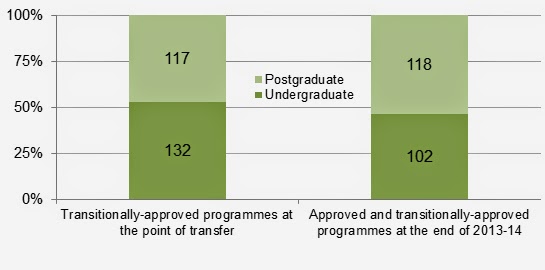
4. A shift in the split between undergraduate and postgraduate programmes sees more social work programmes being delivered at postgraduate level.
At the point of transfer in August 2012, 47% per cent of programmes were delivered at postgraduate level. At the end of the 2013-14 academic year, 54% of programmes were delivered at postgraduate level.
5. All social work programmes visited in the 2013-14 academic year have now successfully completed the approval process.
This means that programmes with conditions placed on them have now evidenced that all conditions have been met. Once a programme has met all our standards through an approval visit it receives what is called 'open-ended' approval. This does not mean these programmes are approved indefinitely. They will need to continue meeting our standards through mandatory engagement year to year with our monitoring processes.
We prefer to keep regular engagement with the programmes we approve, rather than running a re-approval cycle. It allows us to assess incremental changes to programmes largely as and when they occur. Importantly, where significant changes are identified in our monitoring processes, we have mechanisms in place to enable a new approval visit to be initiated if required.
In conclusion
We are pleased to see that the work we have carried out with education providers is proving effective. Over the past two years we have delivered seminars aimed at those providers who were yet to undertake an approval visit, and have supported providers with guidance literature and through our newsletter, Education Update. We were also able to directly address any issues with members of programme teams before their visit. We also widely publicised the findings of our first year review and we’ll be doing the same this year, so have a read and share our findings.
Our second year report is not intended to be a comprehensive review of social worker education in England. We are still part way through our three year programme of visiting transitionally approved social work programmes, and it is too early to draw full conclusions about the impact of the standards of education and training (SETs) in assuring, and driving improvements in, social work education. We intend to begin a more comprehensive review at the end of the 2014-15 academic year.
28 May 2013
Education annual report 2012
Our Education Department approves and monitors education and training programmes throughout the UK. This relates predominantly to pre-registration programmes for the 16 professions we regulate, although we do also approve a small number of programmes linked to post-registration areas of practice. Our standards of education and training (SETs) ensure that a programme that maintains its approval with us produces individuals who are fit to practice and are therefore eligible to apply to our Register. We published the Education annual report 2012 on Tuesday 7 May 2013. Here, we look at some of the key themes from our review of our approval and monitoring activities across the UK during the 2011-12 academic year.
In numbers
During this period we:
- conducted 67 approval visits assessing 110 programmes;
- reviewed 256 annual monitoring declarations and 221 annual monitoring audit submissions;
- considered 316 major change notifications;
- investigated four concerns raised about approved programmes that were within our remit; and
- transferred 269 social work pre-registration programmes and 27 approved mental health professional (AMHP) programmes to our register of approved education and training programmes following the transfer of social workers in England from the General Social Care Council on 1 August 2012.
Conditions for new programmes
A key area of growth over the last three years related to new programmes for practitioner psychologists and hearing aid dispensers following the opening of these Registers in July 2009 and April 2010 respectively. We concluded the schedule of approval visits to these programmes in summer 2012.
A common theme across these programmes was the number of conditions we applied on approval that related to practice placements. Our SETs require an education provider to hold overall responsibility for placement provision. Conditions in this area are therefore often focused on the quality assurance arrangements the education provider has in place to manage these important areas of teaching and learning.
This is a trend we often see with new profession programmes that transfer over to us and with new programmes from our existing professions. Our Visitors normally ask for further evidence that education providers are well placed to manage practice placements and that placement educators are equipped to provide appropriate learning experiences. This often means education providers must demonstrate that there are formal, documented arrangements underpinning the relationships they have with their placement providers. When considered in this context, these results do not suggest any profession-specific risk profile for either new profession.
To help address this across all professions, we have been delivering seminars for the past two academic years that are focused on supporting education providers in their management of placements. For these seminars, we invited both education providers and placement educators to attend as we recognise the important role they each play in ensuring the education experience meets our standards. These seminars were well attended by representatives from the majority of our professions and facilitated useful discussions about different approaches to the management of placement provision.
The MSC initiative
The Modernising Scientific Careers (MSC) initiative – a workforce strategy from the Department of Health – has also had an impact on education programme numbers, with the creation of 16 new biomedical scientist programmes in 2011-12, which we approved. We also approved a new route to registration for clinical scientists modeled against the new MSC scientific training pathway. It is possible that we may see the creation of more new biomedical scientist and clinical scientist programmes in future years as a result of the MSC initiative.
These developments suggest that our standards remain fit for purpose and can be appropriately applied to a range of professions and models of education and training for the professions we regulate.
Monitoring
When compared over the last five years, it is clear that our monitoring workload is growing. For annual monitoring, we have seen an increase of 85 per cent between 2007-08 and 2011-12. Major change notifications also increased by 32 per cent in the 2010-11 academic year. These increases are expected each year, because as we approve more programmes, more programmes are subject to meeting our monitoring processes. We anticipate further growth as practitioner psychologist and hearing aid dispenser programmes move into our monitoring cycle.
We required additional documentation for 41 per cent of annual monitoring audit submissions. This is comparable with the results from last year, which reflects the requirement for education providers to show how they meet the revised SETs implemented in September 2009. All programmes in the annual monitoring cycle have now provided this evidence and we expect the number of requests for additional documentation to fall again next year accordingly.
No programmes required a further approval visit as a result of an audit submission and only 2 programmes required a further approval visit as a result of a major change submission. We only decide to conduct an onsite approval visit when the changes submitted by an education provider have significantly changed the way their programme meets our standards. Pleasingly, these results mean our model of open-ended approval is achieving the task it was set out to do: preventing the need for cyclical re-approval visits where possible.
Looking ahead
We anticipate the majority of our approval and monitoring work over the next three academic years to be focused on the schedule of visits to social work and approved mental health professional (AMHPs) programmes in England.
As with all new professions, we will undertake a review of these visits each year to inform our own approval and monitoring approach for these professions and the application of our standards. This review will also feed into future seminar topics and stakeholder liaison that we conduct with the social work profession.
Brendon Edmonds
Acting Director of Education, HCPC
Notes:
You can download a copy of the full Education annual report 2012 here: www.hcpc-uk.org/publications/reports
Further information on the HCPC’s approval and monitoring activities can be found here: www.hpc-uk.org/education
All programmes approved by the Education and Training Committee for meeting our SETs appear on our register of approved programmes: www.hcpc-uk.org/education/programmes/register
04 March 2013
The role of professional regulation after the Francis inquiry
Last week I attended the King’s Fund conference looking at the outcomes of the public inquiry into the failures in care at the Mid Staffordshire NHS Foundation Trust.The conference was an opportunity for all those with responsibility for health and social care (from funding, to delivery, to regulation and oversight), to come together to continue the process of exploring the fundamental question after any public inquiry – what now?
What will endure with me most in Robert Francis’ opening presentation were the patient stories – the first-hand accounts of truly appalling care. As Robert Francis emphasised, on the whole these were not examples of deviation from good practice, but ‘obvious’ failures in the fundamental standards of care which we should all expect.
Culture and culture change was a consistent theme throughout the day. Robert Francis spoke about the development of a culture at Mid Staffordshire where patients and staff were either not listened to or felt discouraged or disempowered to speak up. A number of the participants in the audience were former NHS staff with a poor experience of reporting and escalating instances of poor patient care. They were keen to ensure that the inquiry led to real change in how whistleblowers were treated and supported, from the actions of the Board in setting the tone for how reports of poor standards were handled, to how whistleblowers were treated by their peers. At times there was a hint of weariness from some in the audience – a fear that reducing the problem and solution to intangible references to culture would be a blueprint for inaction. We were reminded by Robert Francis at the beginning of the day that many of his recommendations could be implemented now and without the need for legislation, there was no need for delay.
So, what role do professional regulators have to play in a ‘post Francis world’? The challenge from Robert Francis was for all organisations to reflect on the report; to evidence their acceptance of the report’s recommendations; and to take effective steps to translate that acceptance into real action. Our Council will begin that process with a paper at its next meeting in a few weeks’ time.
Some of the changes we might need to make are immediately apparent. For example, we have begun the process of reviewing our standards of conduct, performance and ethics and we know as part of that we will want to strengthen our existing requirements about the responsibility of our registrants to report and escalate concerns about poor care. This will build on our existing commitments as part of the NHS Employers Speaking Up Charter. We will also want to continue encouraging and engaging in debates with health and care professionals about professionalism. Francis spoke of a conversation with one professional who described the process of becoming ‘immune to the sound of pain’ in an atmosphere of intense pressure, low staffing levels and even lower morale. How do health and care professionals and their leaders address this kind of pattern?
We need to think about both the role we play as a regulator in setting standards for a range of health and care professionals, and the role this plays in helping to shape the culture. But we also need to think about the wider lessons we can learn from the Francis report for us as an organisation.
We were reminded last week that professional regulation is only one part of a wider jigsaw puzzle that collectively ensures quality and safety, but that certainly shouldn’t exempt us from thinking about the part we can play in taking the ‘post-Francis’ agenda forward. And in doing so, the personal stories of pain and suffering should be uppermost in all of our minds.
Michael Guthrie
Director of Policy and Standards
28 February 2013
Personal reflections post Francis
The enduring and disturbing memory triggered by Francis was of coming to her bedside, to find her distressed, agitated and unable to speak, gesturing frantically to me, pointing to her bed. Her sheets were wet and soiled. I got her out of bed and helped her to sit on the chair. I told her I would go and find help. I went to the nursing station; there was no one there. There appeared to be no one around. I eventually found a nurse and told her what had happened. She looked blankly at me. She said: “I'm the only one here. Everyone else is on a tea break.” I said: “Where are the sheets? Can I change Mrs W?” “No,” she said. “It's not your job.” “But she is very distressed,” I persisted. “She will have to wait until the others come back.” “No,” I said. “She needs help now.” I went back to Mrs W and explained that there were very few nurses about. “I know!” she cried.
For several days afterwards, she was subdued, tired easily and was less motivated to work on her speech. I spoke to colleagues about the incident. I felt there was something wrong with a system that could not respond to distress, still less find it acceptable that a speech and language therapist was interfering in the care of a patient. I don't know how typical this was at the time, of course. Nevertheless, in my view, this should not have happened.
Since those days in the early 1980s, the NHS has gone through at least a dozen re-organisations, as well as witnessing a few major inquiries. Sadly, the same themes recur. From patients, those themes are poor care, not enough staff, not knowing what is happening to them, and lack of involvement in decision making. At worst, they are about neglect, rudeness, and lack of respect from staff. What do staff say? Staff shortages, lack of management support, poor supervision, feelings of disempowerment and disconnection. I have often heard front-line nursing staff say they are too overworked and understaffed to be able to afford the luxury of talking with their patients. Too many demands lead to emotional shut down and apparent lack of compassion.
Francis highlighted for all of us involved in delivering health care that a positive culture and clear lines of accountability are not optional extras. They are fundamental to good care. One element necessary to create and sustain both of these is for professionals to have and maintain a clear sense of purpose and a shared set of values that drive everything they do. Some would call this the heart of professionalism. HCPC has been working over the last few years on a programme of research looking specifically at professionalism. We have known for some time that the majority of complaints are about conduct not technical competence. We wanted to address this, initially through research, and later through dissemination and debate with clinicians, educators and students, as well as within the regulatory community. We published the first report in 2011 and the second will come out in 2015. The wider questions we have posed for those on our Register are: What does being professional mean to you? What do you do if you see unprofessional behaviour in others? Can you have a conversation about difficult things, like being a witness to poor care? How is professionalism learned? How do you cope with the stress of being a professional caregiver, working daily with vulnerable people, dealing with unforeseen illness, disability, distress and uncertainty?
Nothing in the Francis report or in today's discussions leads me to think we need to do less. In fact, stepping up our call to registrants to deal constructively with these difficult issues seems all the more relevant in light of this report. We will be looking closely at our responsibilities as a professional regulator, what more we can contribute, and what needs to change in our standards and our engagement with other agencies. Whatever re-organisation the health service undergoes in the coming months and years, it must not lose sight of the need to address the fundamental commitment to care, which we know is not universally delivered, still less universally understood. In the words of Francis: "Every single person serving patients must contribute to a safer, committed and compassionate and caring service."
This is not just about doctors and nurses. If we do not act collectively, we are all undone.
Anna van der Gaag
28 February 2013
02 August 2012
The end and the beginning: Social workers in England have a new independent regulator
Yesterday marked the beginning of a new chapter in the regulation of social workers in England. From 1 August, all practising social workers in England have to be registered by the re-named Health and Care Professions Council (HCPC). This follows many months of preparation by HCPC in collaboration with the outgoing regulator, the General Social Care Council (GSCC), to ensure a smooth transfer.
What this change means for all social workers in England is that they are required to sign up to a new set of standards. These describe not only the ethics and conduct of their work, also the knowledge and skills expected of them. The HCPC will also require social workers to sign up to new standards on CPD, which are focused on the outcomes of learning, rather than the hours or points system which social workers have been used to. There will be more of a focus on personal responsibility for undertaking learning activities, and a requirement to undertake a wider range of activities, both formal and informal, which contribute to the process of keeping up to date and fit to practise.
The benefits of this new system of regulation are in part to do with HCPC's legislation. We have a wider range of standards, describing social worker competencies as well as conduct. We have stronger powers for dealing with concerns and complaints, which will make the process of investigation more efficient. We have a broader range of sanctions when dealing with concerns about a social worker’s fitness to practise, for example we can impose conditions on a social workers practise, ensuring that they receive supervision or re-training if their practise falls below our standards.
Taken together, these new standards, powers and sanctions will allow us to protect the public from poor practitioners and affirm the high standards in the profession. However, regulators do not operate in isolation. We will be building on the achievements of GSCC, working with the profession, with professional bodies, service users, advocacy groups and unions, as well as with educators to ensure that registered social workers in England are practising safely and effectively.
Over the last two years I have learned much about social work practise from listening to social workers and service users. Society has high expectations of those who practise as social workers. The work of a social worker is frequently challenging, often complex, and rarely acknowledged. For every one social worker who falls below national standards, there are many hundreds whose commitment and service to children and adults bring lifelong benefits and significant improvements. A huge amount has rightly been invested in the profession in recent years and the work of the Munro team, the Social Work Reform Board, and most recently, the new guidance on safeguarding children and the Social Care White Paper, are all promoting the vision of a stronger, more confident profession for the 21st century. HCPC, as the newly appointed independent statutory regulator of social workers in England, is looking forward to contributing to this vision. We will be working closely with our colleagues in the Care Councils in Scotland, Wales and Northern Ireland, whose experience and insights have already proved invaluable to us.
Yesterday also marked the end of an important chapter in the regulation of social workers. The outgoing regulator, the GSCC, has made a significant contribution to the profession. It established the first statutory register of social workers in England 11 years ago, developed the first standards and redefined the entry requirements for education. Perhaps most significantly, GSCC was far sighted in its approach to involving service users in decision making. Their legacy work on ensuring that the lessons learned during this important period will be disseminated and carried forward have been very well received, and will continue to influence social work practise into the next decade and beyond.
On behalf of HCPC, I would like to thank the Council and Executive at GSCC for working with us over many months, and pay tribute to their professionalism and commitment.
Anna van der Gaag
Chair