Showing posts with label education and training. Show all posts

21 August 2015

6 things you should know about the HCPC’s Education and Training Committee

Education Manager, Tracey Samuel-Smith, explains the key roles of our Education and Training Committee (ETC) and how their decisions can impact education providers.

The ETC is a statutory committee of the Council, and advises on matters relating to education, training and registration. Members of the Committee make up the Education and Training Panels who deal with visitor’s reports from the approval and monitoring processes. Their decisions directly impact education providers so it’s important to understand their role. 

Here’s six things that, as an education provider,
you should know about the ETC:


1. The Education and Training Committee consider recommendations from appointed visitors about whether a programme has met the appropriate standards.

2. The Education and Training Committee comprises six members of Council - three registrant and three lay members (in accordance with our Code of Corporate Governance). As such, not all of our regulated professions are represented on the Committee. Therefore they use visitor recommendations to make a final decision on programme approval and ongoing approval.

3. The Education and Training Committee will consider input from education providers, who have the opportunity to contribute to the decision-making process by submitting observations on any condition or recommendation in a visitors’ report. 

4. The Committee can vary any condition or recommendation in a visitors’ report. For example when they decide a condition exceeds threshold or is not relevant to a standard.

5. The Committee can withdraw approval from any education or training programme that closes or no longer meets our standards.

6. The Education and Training Panel sits ten times per year. Dates of panel meetings are available on the HCPC website. These dates should be considered by education providers planning a visit or undertaking a significant change to a programme.

For more information about the HCPC’s Education and Training Committee, visit www.hcpc-uk.org/aboutus/committees


16 March 2015

AMHP training and education programmes: how can the conditions set during 2013/14 approval visits inform and guide education providers?

This was one of the key questions considered by our education team following the first year review of approval visits to AMHP programmes. Education Manager, Ben Potter, explains.

As part of the transfer of the General Social Care Council’s (GSCC) regulatory functions to the HCPC in August 2012, we became responsible for approving and monitoring AMHP education and training programmes in England.

All approved AMHP programmes are required to meet our criteria and conditions can be placed on programmes that do not. These conditions must be met before we can approve or continue to approve a programme.

During the 2013-14 academic year we considered 17 programmes at 11 education providers. We are scheduled to visit a further ten transitionally approved programmes at eight providers in 2014-15.

All AMHP education and training programmes visited in 2013/14 have now demonstrated how they have met any conditions placed on them – thus demonstrating how they meet our criteria – and are now approved.

To help, inform and guide education providers for the future, here we consider the two areas that incurred the highest number of conditions so that we can provide further understanding of certain aspects of our approval criteria. Our full report – Review of the Health and Care Professions Council (HCPC) approval visits to approved mental health professional (AMHP) education and training programmes in the 2013-14 academic year – is available to download.

Practice placements

As an education provider, you need to own and manage practice placements, including policies and procedures around approval and monitoring of placement settings; the staff in place; and ensuring that placement settings provide a safe and supportive environment.

When setting conditions in these areas, we often found that education providers would not own the policies, or would make assumptions that the placements were well-resourced in terms of staff, due to them being in statutory settings.

There were also assumptions by education providers that placements were providing a safe and supportive environment for students, due to the post registration nature of these programmes meaning that students were often employees of the organisation that provided their placements.

When we applied conditions in this area, education providers had often not considered that these employees / students need to be supported differently when undertaking activities to support their AMHP training in their place of work, when compared to how they need to be supported when carrying out their day to day role.

Documentation

Documentation underpins how programmes run in every area. We require documentation to communicate expectations about how a programme will interact with its stakeholders – including students, placement providers, and staff – and that it clearly defines the roles and responsibilities of all parties in the running of the programme.

As an education provider, if your documentation is of a poor standard, we are unable to make a well-informed judgement about whether particular criterion are met. When we are unable to fully assess and reach a decision, we need to apply a condition to ensure that the criterion is met.

How can understanding these key issues help to inform a future approval visit?

As an organisation, we have learnt a great deal from these visits and about how we will aim to help, inform and guide education providers participating in future visits.

You can find a range of guidance about our approval visits on the HCPC website. There are also online resources, featuring case studies and presentations from our seminars delivered to education providers in autumn 2014.

If your AMHP programme is being approved in 2015, or if you would like advice about the AMHP approval criteria, you can contact the member of our team allocated to manage your approval visit, or you can email education@hcpc-uk.org.


23 February 2015

The 5 W’s of the amended approvals process for supplementary and independent prescribing programmes

Head of Educational Development, Brendon Edmonds, summarises the HCPC’s recent review of the amended approval process for supplementary and independent prescribing (SPIP) post-registration programmes.

An introduction to independent prescribing

Independent prescribing is prescribing by an appropriately qualified practitioner responsible for the assessment of patients with undiagnosed or diagnosed conditions, and for decisions about the clinical management. Independent prescribers can prescribe any medicine for any medical condition within their competence.

In 2009, the Department of Health (DH) published a report looking at the use of medicines by the allied health professions (AHPs). The report looked at whether prescribing and medicine supply mechanisms for AHPs should change to address patient and service needs. It found a strong case for extending independent prescribing to chiropodists/podiatrists and physiotherapists. In July 2012, the DH announced that legislation would be passed to allow appropriately trained chiropodists/podiatrists and physiotherapists to act, and be annotated on our Register, as independent prescribers.

As a result of this new legislation, the HCPC developed and published standalone standards for prescribing. We also amended the approval process for supplementary and independent prescribing (SPIP) post-registration programmes, which was reviewed in the 2013-14 academic year.

Here, we summarise the review and its key findings. The full report is available to download here.

WHEN…
 
When did the HCPC’s standards for prescribing come into effect following the revised legislation?

As part of the legislative change, we produced standards for prescribing. These came into effect from August 2013, following the legislation passing.

To develop these standards, we engaged with stakeholders and undertook a public consultation. The standards cover two areas: standards for education providers and standards of SPIP prescribers. The standards for education providers are based on our standards of education and training, whilst those for all prescribers are proficiency based, and expand upon the standards of proficiency required of chiropodists/podiatrists, physiotherapists and radiographers who undertake supplementary prescribing.

WHY...
 
Why does the HCPC have an amended approval process for SPIP post-registration education and training programmes?

The development of this amended approval process was a direct response to the DH changes to prescribing legislation in 2012.

It was already commonplace for education providers to deliver independent prescribing (IP) programmes for professions that we don’t regulate (pharmacists and nurses) and supplementary prescribing (SP) for ones that we do (physiotherapists, radiographers and chiropodists/podiatrists).

However, we needed to be sure that independent prescribing could be supported for our professions and in relation to our prescribing standards.  As we already approve SP programmes, we were satisfied that new independent prescribing programmes would already meet some of the standards for prescribing. We were also satisfied we didn’t need to conduct a full approval visit to assess them - hence the need for an amended approval process.

This gave eligible education providers the opportunity to gain approval for prescribing programmes in a significantly shorter timeframe than our standard approval process. In fact on average, programmes were approved ten weeks after their documentary submission – less than half the average time taken for programmes via the full process (22 weeks).

This really demonstrates how we’re able to amend our processes to support the work and initiatives of health and care providers.

WHO…
 
Who did the legislative changes affect and how did this impact education providers?

The changes to prescribing legislation meant that our chiropodist/podiatrist and physiotherapist registrants could act as independent prescribers once appropriately trained and annotated on our Register.

Prior to, and soon after, the legislation being passed, we wrote to education providers which delivered approved supplementary prescribing (SP) programmes to let them know how the amended approval process would work. We also advised them we would assess their programmes against the newly published standards for prescribing.  

Our process reduced the burden of work required for education providers to evidence how they met the required standards when compared to the full approval process. This was because they were only required to focus on the standards which were directly impacted by the introduction of independent prescribing. 

WHERE…  
 
Where did the HCPC find its visitors for the approvals and monitoring work?

We work with visitors who make the assessments of programmes to ensure they meet our standards. For prescribing, we set rules about selecting visitors for this specific area of approvals and monitoring work.

Our visitors work together in pairs to make an assessment.  At least one of the visitors had to be from a non-medical prescribing profession which was entitled to undertake independent prescribing training (a nurse or pharmacist). This visitor was required to be registered, with the entitlement recorded on their respective register.

We also recruited independent prescribing visitors to competencies that were based on the competencies for the visitors of our 16 professions.

WHAT…

What were the key outcomes of the amended approval process?

We reviewed 100 prescribing programmes at the assessment days in November 2013.

Visitors were able to request further documentation if they were not satisfied that a standard was met following their review of the documentation. Visitors could also recommend a full approval visit if there were issues remaining following their assessment of a programme. 62 per cent of the programmes assessed met the standards for education providers without the need for additional documentation, as demonstrated in the graph below. This outcome contrasts with the full approval process, where only three per cent of programmes visited in 2012/13 were approved following our first assessment.

So why was this?


There are a number of reasons:
  • Education providers were not fundamentally altering their existing prescribing provision to incorporate independent prescribing.
  • All of the education providers that engaged with this process ran existing HCPC approved SP programmes, and many ran IP programmes for nurses and pharmacists.  
  • The education providers were already familiar with our standards and processes.
Programmes required to submit further documentation were able to evidence how they met our standards, and all 100 prescribing programmes were approved by February 2014. None of the programmes required a follow up approval visit. Therefore, we have granted open-ended approval to these programmes and it will remain in place, subject to meeting our ongoing monitoring requirements.

The outcome of approving these programmes is that individuals from the relevant professions can have their registration record annotated as an independent prescriber, once they complete the relevant training. To date, we have updated the records of 150 registrants with the independent prescribing annotation. 

04 February 2015

5 key findings from social work programme approvals

Jamie Hunt, Education Manager at the HCPC, talks through some of the observations and trends following the second year of social work programme approval visits.

The 2013-14 academic year saw the Education team complete the second year of approval visits to social work programmes. In total we visited 113 programmes at 43 education providers, 16 of which were new programmes.

The purpose of the process is to ensure an education provider:
  • has a robust framework to manage all aspects of their programme effectively;
  • holds responsibility for all aspects of their programme, including placement environments;
  • has curriculum and assessment which support the delivery of our standards of proficiency for social workers in England, and;
  • can make good decisions about those individuals who receive the final approved award.
If we find areas which do not meet our standards following an approval visit, we will set conditions which must be met before it can be approved.

With other professions previously new to HCPC regulation, we’ve found that education providers better understand our quality assurance approach over time, and therefore work effectively to align their programmes to our standards. This usually means that as the series of approval visits progresses, the fewer issues we identify. This was certainly true of our approval visits to social work programmes in the 2013-14 academic year, in comparison to the previous year.

Here, we have summarised some of the key observations and trends. Our full report – Review of the Health and Care Professions Council (HCPC) approval visits to social work pre-registration education and training programmes in the 2013-14 academic year – is available to download on our website.

Social work programme approval visits 2013-14: 5 key findings

1. On average, we applied 1.8 fewer conditions per social work programme in the 2013-14 academic year compared to the previous year. 


This result suggests social work education providers are becoming more familiar with our regulatory requirements. They are successfully providing the evidence to meet our standards prior to and at the visit itself.

2. Education providers are more aware of the importance of managing issues regarding student consent.

SET 3.14 requires education providers to ensure that: “where students participate as service users in practical and clinical teaching, appropriate protocols must be used to obtain their consent”.

Last year, we found we applied conditions to 56% of programmes but this has dropped to 33% in year two. This suggests there is greater understanding amongst programme teams regarding getting informed consent from students where they are involved in role play or are sharing personal information. 

3. Many of the conditions we placed on programmes were linked to:
  • Inadequate programme documentation
One way to demonstrate a robust framework is in place to manage a programme is ensuring all areas are clearly documented. This is why we ask education providers to submit copies of key programme documents (e.g. programme and placement handbooks). We commonly set conditions where we find inconsistency, or an absence of information, in these documents which could affect a stakeholder’s engagement with a programme.
  • A lack of documented policies and systems, used to manage a range of programme areas
To approve a programme, policies and systems must be in place, written down and appropriately applied. As a regulator, we do not solely rely on the establishment of good will and long-standing relationships between various stakeholders to support a programme’s delivery. We need to be satisfied an education provider can effectively identify, manage, mitigate and learn from issues and risks and in doing so, maintain the level of quality that our standards require of them.
  • Clarity regarding how the programme meets Standards of Education and Training (SETs) and supports individuals meeting our Standards of Proficiency (SOPs)
Education providers need to clearly identify how their programme aligns to our standards. This can take time and this is one of the reasons we provide education providers with a six month lead in time to the visit itself. Careful thought is needed to consider how the programme meets our SETs and SOPs and it is important that this is mapped clearly for the benefit of our visitors who will assess the programme. This process of mapping should also allow an education provider to identify any potential gaps in how they meet our standards prior to the visit.

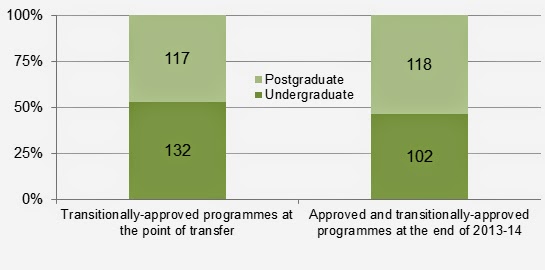
4. A shift in the split between undergraduate and postgraduate programmes sees more social work programmes being delivered at postgraduate level.

At the point of transfer in August 2012, 47% per cent of programmes were delivered at postgraduate level. At the end of the 2013-14 academic year, 54% of programmes were delivered at postgraduate level.


5. All social work programmes visited in the 2013-14 academic year have now successfully completed the approval process.

This means that programmes with conditions placed on them have now evidenced that all conditions have been met. Once a programme has met all our standards through an approval visit it receives what is called 'open-ended' approval. This does not mean these programmes are approved indefinitely. They will need to continue meeting our standards through mandatory engagement year to year with our monitoring processes.

We prefer to keep regular engagement with the programmes we approve, rather than running a re-approval cycle. It allows us to assess incremental changes to programmes largely as and when they occur. Importantly, where significant changes are identified in our monitoring processes, we have mechanisms in place to enable a new approval visit to be initiated if required.

In conclusion

We are pleased to see that the work we have carried out with education providers is proving effective. Over the past two years we have delivered seminars aimed at those providers who were yet to undertake an approval visit, and have supported providers with guidance literature and through our newsletter, Education Update. We were also able to directly address any issues with members of programme teams before their visit. We also widely publicised the findings of our first year review and we’ll be doing the same this year, so have a read and share our findings.

Our second year report is not intended to be a comprehensive review of social worker education in England. We are still part way through our three year programme of visiting transitionally approved social work programmes, and it is too early to draw full conclusions about the impact of the standards of education and training (SETs) in assuring, and driving improvements in, social work education. We intend to begin a more comprehensive review at the end of the 2014-15 academic year.


14 February 2014

HCPC seminar series asks: Who are your service users?

The new standard of education and training

Following research in 2012 and consultation last year, we have decided to amend the standards to require the involvement of service users and carers in all approved programmes. This recognises the important role this involvement plays in ensuring students are fit to practise at the point they complete their programmes and join the Register.

The new standard states: "Service users and carers must be involved in the programme."

Service user and carer involvement seminars

To introduce the new standard support education and training providers, we have held a series of seminars throughout the UK.

At these seminars, delegates were given a brief overview of the new standard and what it means for them as education providers, before undertaking some group activities to determine who they can involve in their programme and how. Education providers were given the unique opportunity to play the HCPC’s ‘Service User and Carer Card Game’.

For this, delegate groups were given a series of cards detailing fictional characters and asked to decide who would be service users or carers for a certain HCPC profession, under the new standard’s guidance. Taryn, a barmaid who participates in research studies, and Charles, a welfare benefits solicitor, were just two of the 26 characters, who each sparked some thought-provoking questions and discussions between delegates, such as:
  • Are the service users and carers necessarily individuals or can they be groups or organisations?
  • Are they all direct users of the services for a profession or can the perspectives of those indirectly affected by the work of health and care professionals be relevant?
  • Are they the end users of a service or might intermediate users of services, such as other professionals, also have valuable contributions?
  • And to what extent can different groups or individuals get involved in an education and training programme?
“The game was a great way to think about who service users and carers might be. I’d like to bring it back to my own team.”
Using scenarios, delegates then built on these themes, comparing possible approaches that education programmes might take and looking at some of the potential barriers and benefits that may arise.
Recruitment, support, representativeness and avoiding tokenism were all topics for consideration, whilst also looking at the appropriateness of involvement activities in the context of the other SETs.

The seminars also featured videos to encourage reflection and discussion around the theme, which triggered some delegates to consider the use of digital media and platforms in embedding service user and carer contributions in education or training programmes.


Service user representatives attended some sessions, enriching the discussions with invaluable insights into the education and training of professionals from their perspective.

The seminars proved an important opportunity for education providers to share their experiences with representatives from other professions and programmes, and talk to us about our expectations for the new standard.

“I found the activities very thought provoking.”
“I have learned a great deal about the HCPC today as well.”

Service user and carer involvement and you

What do you think are some of the approaches you could take to involve service users in your own programme? What are some of the challenges? Do you have experience with a successful way to involve service users? Please share your thoughts and comments below.

Nicola Baker
Education Officer
HCPC

Notes:
  • Download a copy of the new standard and supporting guidance here [PDF]. 
  • We will be rolling out the new standard on a phased basis and will apply as follows.
    • From 2014–15 - new programmes, transitionally approved programmes and programmes requiring a visit as a result of a major change or annual monitoring submission.
    • From 2015–16 - all other approved programmes, including prescribing programmes, formally assessed through annual monitoring
    • Immediately -  Approved Mental Health Professional (AMHP) programmes at approval visits.
  • If you have any questions about the new standard and what it means for education and training providers, please contact us at education@hcpc-uk.org 
  • Education seminars take place each year on relevant topics for education and training providers. You can find out more information here.

18 November 2013

A look back at the first year of social work programme approvals

When the Register for social workers in England opened on 1 August 2012, we became responsible for the 249 pre-registration social work programmes that had previously been approved by the General Social Care Council (GSCC). To ensure these programmes meet our standards of education and training (SETs), we will visit each of these programmes to confirm their approval.

We held the first year of these approval visits during the 2012–13 academic  year and will continue with the visits for another two years As with all professions new to the HCPC, we have completed a review of this first year of approval visits to social work programmes.

Considering the other recent, non-regulatory changes in the social work education sector, we expected there would be significant changes to education providers’ social work provision.

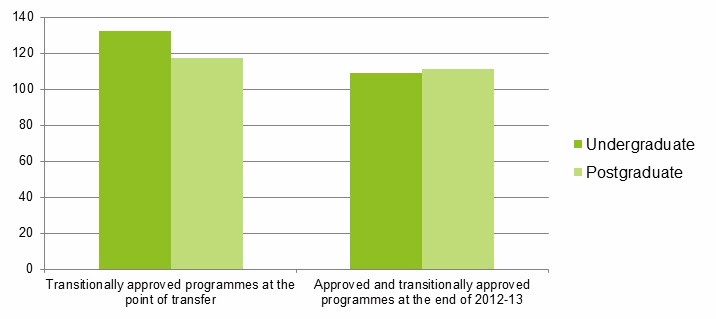
One thing we saw was a twelve per cent reduction in the number of approved and transitionally approved programmes a year after the transfer. Of the 82 education providers running transitionally approved programmes at the point of transfer, 79 continued to deliver social work programmes, with three closing their social work provision entirely. The graph below shows how these closures have affected the split between approved undergraduate and postgraduate programmes over the last year. You can read more about these changes in the full paper, which you can view on our website here.

Comparison of programme numbers at the point of transfer and at the end of the 2012–13 – by qualification level


We also noted that there were significant changes to some programmes in areas such as curriculum design and delivery, and practice placements standards as they adapted to meet our standards, but also due to the recommendations of the Social Work Task Force, including The College of Social Work’s (TCSW) Professional Capabilities Framework.

Our review shows that the approval process was implemented effectively and that we have learned from the recent onboarding of other professions, such as hearing aid dispensers and practitioner psychologists. Specifically, as part of the preparation for the onboarding of the profession, we ensured that we worked closely with TCSW, holding regular meetings and developing a suggested agenda for joint approval / endorsement events.

In the full paper, we have provided detailed analysis about which standards had a higher number of conditions set, and have discussed reasoning for why we needed to set more conditions for these standards. Education providers, in particular those who have yet to have their visit, may find the full report useful in preparing for their own visits.

In particular, we have noted that many conditions were set in several of our broad SET areas, specifically those related to curriculum and assessment (SET 4 and 6), practice placements (SET 5), and programme management (SET 3). However, it is important to note that these are not issues that are specific to social worker programmes in meeting our standards. We expect to see conditions in these areas when onboarding any new profession or visiting new programmes from existing professions.

Number of conditions for social work programmes in 2012–13 – by broad areas of the standards of education and training


Where necessary, programmes have implemented changes to ensure our regulatory requirements are met. This shows that our standards, which are designed to be broad and flexible, can be applied across different professions and education programmes.

All social work programmes that we visited in the 2012-13 academic year have now successfully completed the approval process. The programmes now have ongoing approval confirmed, subject to satisfactory monitoring. We will continue to review the outcomes from our approval visits to social work programmes on a regular basis throughout the next two academic years.

Jamie Hunt
Education Manager
HCPC


Notes:

View the full review paper at www.hcpc-uk.org/assets/documents/100042FESWapprovalreview12-13.pdf

Find out more about our education processes at www.hcpc-uk.org/education/

30 September 2013

Review of the process of HCPC approval of practitioner psychologist pre-registration education and training programmes

On 1 July 2009, the British Psychological Society (BPS) transferred its regulatory responsibilities to the HCPC and practitioner psychologists became the fourteenth profession to join the HCPC Register.

In addition to agreeing new standards for the profession, the HCPC became responsible for all the pre-registration programmes which transferred from the Society.  Over the following three years, we visited each of these programmes to confirm their approval against our standards.


As with all new professions, we have undertaken a review of these visits to look at what, if any, key trends emerge.

From the review, we have identified that the approval process was implemented effectively and there were no outstanding issues specific to this profession. Importantly, this shows how our standards, which are designed to be broad and flexible, can be applied across different professions and education programmes.

The review also enabled us to identify where work was greatest over the past three years, if it was what we expected and what we can learn from the process. Specifically, we have used the findings of the review to develop the process of opening the Register to other new professions.

In particular, it has helped us to identify the most efficient way to transfer and utilise information about education and training programmes from previous regulatory or professional bodies. We have also been able to develop our communication with new professions and education professionals to make sure we effectively communicate who we are and what we do to ease the transition for those directly involved.

These developments have been put to good use as we have since welcomed hearing aid dispensers and then social workers in England onto the Register.

The findings in detail

It is clear from our review that no trends emerged that are specific to practitioner psychologist programmes when compared to programmes from the other professions we regulate. All 98 practitioner psychologist programmes we visited were granted approval or had approval reconfirmed.

Although the number of conditions set against each of the practitioner psychologist programmes  varied, the overall average when compared with all other programmes visited over the same period was exactly the same. The particular standards against which conditions were set also mirrored those most commonly set on programmes from other professions.
 
Number of conditions set on programmes between 2009 and 2012


Percentage of conditions set on programmes between 2009 and 2012


This is a very positive outcome as the results do not suggest that a profession-specific risk profile has emerged or that there are any difficulties in meeting our regulatory standards.

We will now monitor and review how practitioner psychologist  programmes interact with the established monitoring and major change processes to see if any specific trends emerge and, if so, what lessons can be learned from this.

Ben Potter
Education Manager, HCPC


Notes:
Download a copy of the full  report
www.hcpc-uk.org/aboutus/committees/archive/index.asp?id=652

Detailed information on the HCPC’s approval and monitoring processes can be found here: www.hcpc-uk.org/education/processes

All HCPC- approved programmes, including practitioner psychologist programmes, appear on our register of approved programmes: www.hcpc-uk.org/education/programmes/register   

28 May 2013

Education annual report 2012


Our Education Department approves and monitors education and training programmes throughout the UK. This relates predominantly to pre-registration programmes for the 16 professions we regulate, although we do also approve a small number of programmes linked to post-registration areas of practice. Our standards of education and training (SETs) ensure that a programme that maintains its approval with us produces individuals who are fit to practice and are therefore eligible to apply to our Register.

We published the Education annual report 2012 on Tuesday 7 May 2013. Here, we look at some of the key themes from our review of our approval and monitoring activities across the UK during the 2011-12 academic year.

In numbers
During this period we:
  • conducted 67 approval visits assessing 110 programmes;
  • reviewed 256 annual monitoring declarations and 221 annual monitoring audit submissions;
  • considered 316 major change notifications;
  • investigated four concerns raised about approved programmes that were within our remit; and 
  • transferred 269 social work pre-registration programmes and 27 approved mental health professional (AMHP) programmes to our register of approved education and training programmes following the transfer of social workers in England from the General Social Care Council on 1 August 2012.
The video below provides a brief overview of key facts and figures from this year's report:


Conditions for new programmes
A key area of growth over the last three years related to new programmes for practitioner psychologists and hearing aid dispensers following the opening of these Registers in July 2009 and April 2010 respectively. We concluded the schedule of approval visits to these programmes in summer 2012.

A common theme across these programmes was the number of conditions we applied on approval that related to practice placements. Our SETs require an education provider to hold overall responsibility for placement provision. Conditions in this area are therefore often focused on the quality assurance arrangements the education provider has in place to manage these important areas of teaching and learning.

This is a trend we often see with new profession programmes that transfer over to us and with new programmes from our existing professions. Our Visitors normally ask for further evidence that education providers are well placed to manage practice placements and that placement educators are equipped to provide appropriate learning experiences. This often means education providers must demonstrate that there are formal, documented arrangements underpinning the relationships they have with their placement providers. When considered in this context, these results do not suggest any profession-specific risk profile for either new profession.

To help address this across all professions, we have been delivering seminars for the past two academic years that are focused on supporting education providers in their management of placements. For these seminars, we invited both education providers and placement educators to attend as we recognise the important role they each play in ensuring the education experience meets our standards. These seminars were well attended by representatives from the majority of our professions and facilitated useful discussions about different approaches to the management of placement provision.

The MSC initiative
The Modernising Scientific Careers (MSC) initiative – a workforce strategy from the Department of Health – has also had an impact on education programme numbers, with the creation of 16 new biomedical scientist programmes in 2011-12, which we approved. We also approved a new route to registration for clinical scientists modeled against the new MSC scientific training pathway. It is possible that we may see the creation of more new biomedical scientist and clinical scientist programmes in future years as a result of the MSC initiative.

These developments suggest that our standards remain fit for purpose and can be appropriately applied to a range of professions and models of education and training for the professions we regulate.

Monitoring
When compared over the last five years, it is clear that our monitoring workload is growing. For annual monitoring, we have seen an increase of 85 per cent between 2007-08 and 2011-12. Major change notifications also increased by 32 per cent in the 2010-11 academic year. These increases are expected each year, because as we approve more programmes, more programmes are subject to meeting our monitoring processes. We anticipate further growth as practitioner psychologist and hearing aid dispenser programmes move into our monitoring cycle.

We required additional documentation for 41 per cent of annual monitoring audit submissions. This is comparable with the results from last year, which reflects the requirement for education providers to show how they meet the revised SETs implemented in September 2009. All programmes in the annual monitoring cycle have now provided this evidence and we expect the number of requests for additional documentation to fall again next year accordingly.

No programmes required a further approval visit as a result of an audit submission and only 2 programmes required a further approval visit as a result of a major change submission.  We only decide to conduct an onsite approval visit when the changes submitted by an education provider have significantly changed the way their programme meets our standards. Pleasingly, these results mean our model of open-ended approval is achieving the task it was set out to do: preventing the need for cyclical re-approval visits where possible.

Looking ahead
We anticipate the majority of our approval and monitoring work over the next three academic years to be focused on the schedule of visits to social work and approved mental health professional (AMHPs) programmes in England.

As with all new professions, we will undertake a review of these visits each year to inform our own approval and monitoring approach for these professions and the application of our standards. This review will also feed into future seminar topics and stakeholder liaison that we conduct with the social work profession.

Brendon Edmonds
Acting Director of Education, HCPC

Notes:

You can download a copy of the full Education annual report 2012 here: www.hcpc-uk.org/publications/reports

Further information on the HCPC’s approval and monitoring activities can be found here: www.hpc-uk.org/education

All programmes approved by the Education and Training Committee for meeting our SETs appear on our register of approved programmes: www.hcpc-uk.org/education/programmes/register

23 April 2012

Service user involvement in the design and delivery of approved programmes

In 2011, we asked researchers at Kingston University and St George’s (University of London) to undertake some research for us looking at the involvement of service users in the design and delivery of education and training programmes approved by the HPC. The research included a literature review; a survey of education providers; and focus groups with students, educators and service users. The final research report is now available to download from our website. I would like to thank all the educators, service users and students who participated in the research.
Most previous research on this topic is about medicine, nursing and social work education, so we hope that this work will make a positive contribution to this area. The research should be useful for education providers thinking about how they might involve service users in their programmes.

Q. Why did we commission research in this area?

Our standards of education and training guidance already encourage education providers to provide evidence of service user involvement in their programmes. However, involvement is not currently an explicit part of the standards, so it is possible we could approve a programme which did not involve service users at all.

In August 2012 we will become responsible for regulating social workers in England. Service user and carer involvement is a particular focus in social work education. There are existing regulatory requirements that service users and carers should be involved in all aspects of social work programmes – including in selection, teaching, assessment and quality assurance.

We have been considering whether we might strengthen our requirements in this area by amending our standards of education and training to require service user involvement for a programme to be approved with us and commissioned the research to help us in making that decision. We wanted to find out more about good practice in involving service users in education and training programmes; the extent and types of involvement activities already undertaken by education providers whose programmes we approve; and to learn more about the drivers, benefits and challenges of involving service users.

Q. What were the research findings?

There were no programmes that did not involve service users in some way in how they were designed (e.g. monitoring and evaluation of programmes) and/or delivered (e.g. selection, teaching, assessment). Service user involvement was most common in the area of programme planning. There were no notable trends between different professions or between different types of programme or education provider.

Most involvement activity is piecemeal rather than systematic. There was limited evidence to demonstrate a clear, causal link between service user involvement and outcomes such as improvements in the quality of treatment and care. However, overall, the research indicated that service user involvement is likely to, or is perceived to have a number of positive effects, including programmes which better reflect the needs and wishes of users of services, resulting in practitioners who are able to involve service users in decisions about their care or services.
One challenge was the definition of service users. A variety of different potential service users were identified, including patients, clients, carers and colleagues. The term was used differently in the literature and by stakeholders involved in the research and it was acknowledged that some professions do not have direct patient or client facing contact. The term ‘end recipient of a service’ was suggested as a means to define the scope of the term. A variety of facilitators and barriers to involvement were identified including funding, leadership and the representativeness and vulnerability of service users. There was general support for amending the standards of education and training, with some caveats and concerns about the need for a standard; the scope of the standard; and the practicalities of meeting it.

Q. What have we concluded?

The research was discussed by our Education and Training Committee at its meeting in March 2012. The Committee agreed that service user involvement in approved programmes was important and, in principle, that an additional standard of education and training could act as a driver for education providers to involve service users in their programmes, sending out a strong message that service user involvement is important for public protection.

The research revealed general support for a standard but with some concerns and caveats. We want to develop a proposed standard which is enabling and meaningful. It needs to be applicable across the diversity of professions and programmes we approve, allowing for flexibility whilst setting an appropriate threshold benchmark for all.

If we were to agree a new standard, we would propose that education providers should have a longer than normal lead-in period so that we can communicate our requirements clearly to education providers, for example, via ‘Education update’ and in our annual seminars with education providers. This will also allow education providers the time to make any changes to their programmes which might be necessary.

Q. What happens next?

We will be considering the wording of a proposed standard and supporting guidance at our next Education and Training Committee meeting in June 2012. Subject to Committee and Council approval, we currently anticipate that a public consultation on the proposed standard and guidance might take place from September 2012.

Michael Guthrie
Director of Policy and Standards
HPC