Showing posts with label Social work. Show all posts

04 February 2015

5 key findings from social work programme approvals

Jamie Hunt, Education Manager at the HCPC, talks through some of the observations and trends following the second year of social work programme approval visits.

The 2013-14 academic year saw the Education team complete the second year of approval visits to social work programmes. In total we visited 113 programmes at 43 education providers, 16 of which were new programmes.

The purpose of the process is to ensure an education provider:
  • has a robust framework to manage all aspects of their programme effectively;
  • holds responsibility for all aspects of their programme, including placement environments;
  • has curriculum and assessment which support the delivery of our standards of proficiency for social workers in England, and;
  • can make good decisions about those individuals who receive the final approved award.
If we find areas which do not meet our standards following an approval visit, we will set conditions which must be met before it can be approved.

With other professions previously new to HCPC regulation, we’ve found that education providers better understand our quality assurance approach over time, and therefore work effectively to align their programmes to our standards. This usually means that as the series of approval visits progresses, the fewer issues we identify. This was certainly true of our approval visits to social work programmes in the 2013-14 academic year, in comparison to the previous year.

Here, we have summarised some of the key observations and trends. Our full report – Review of the Health and Care Professions Council (HCPC) approval visits to social work pre-registration education and training programmes in the 2013-14 academic year – is available to download on our website.

Social work programme approval visits 2013-14: 5 key findings

1. On average, we applied 1.8 fewer conditions per social work programme in the 2013-14 academic year compared to the previous year. 


This result suggests social work education providers are becoming more familiar with our regulatory requirements. They are successfully providing the evidence to meet our standards prior to and at the visit itself.

2. Education providers are more aware of the importance of managing issues regarding student consent.

SET 3.14 requires education providers to ensure that: “where students participate as service users in practical and clinical teaching, appropriate protocols must be used to obtain their consent”.

Last year, we found we applied conditions to 56% of programmes but this has dropped to 33% in year two. This suggests there is greater understanding amongst programme teams regarding getting informed consent from students where they are involved in role play or are sharing personal information. 

3. Many of the conditions we placed on programmes were linked to:
  • Inadequate programme documentation
One way to demonstrate a robust framework is in place to manage a programme is ensuring all areas are clearly documented. This is why we ask education providers to submit copies of key programme documents (e.g. programme and placement handbooks). We commonly set conditions where we find inconsistency, or an absence of information, in these documents which could affect a stakeholder’s engagement with a programme.
  • A lack of documented policies and systems, used to manage a range of programme areas
To approve a programme, policies and systems must be in place, written down and appropriately applied. As a regulator, we do not solely rely on the establishment of good will and long-standing relationships between various stakeholders to support a programme’s delivery. We need to be satisfied an education provider can effectively identify, manage, mitigate and learn from issues and risks and in doing so, maintain the level of quality that our standards require of them.
  • Clarity regarding how the programme meets Standards of Education and Training (SETs) and supports individuals meeting our Standards of Proficiency (SOPs)
Education providers need to clearly identify how their programme aligns to our standards. This can take time and this is one of the reasons we provide education providers with a six month lead in time to the visit itself. Careful thought is needed to consider how the programme meets our SETs and SOPs and it is important that this is mapped clearly for the benefit of our visitors who will assess the programme. This process of mapping should also allow an education provider to identify any potential gaps in how they meet our standards prior to the visit.

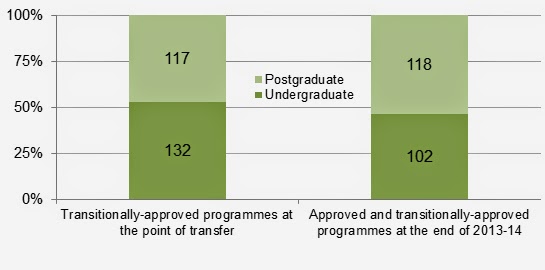
4. A shift in the split between undergraduate and postgraduate programmes sees more social work programmes being delivered at postgraduate level.

At the point of transfer in August 2012, 47% per cent of programmes were delivered at postgraduate level. At the end of the 2013-14 academic year, 54% of programmes were delivered at postgraduate level.

5. All social work programmes visited in the 2013-14 academic year have now successfully completed the approval process.

This means that programmes with conditions placed on them have now evidenced that all conditions have been met. Once a programme has met all our standards through an approval visit it receives what is called 'open-ended' approval. This does not mean these programmes are approved indefinitely. They will need to continue meeting our standards through mandatory engagement year to year with our monitoring processes.

We prefer to keep regular engagement with the programmes we approve, rather than running a re-approval cycle. It allows us to assess incremental changes to programmes largely as and when they occur. Importantly, where significant changes are identified in our monitoring processes, we have mechanisms in place to enable a new approval visit to be initiated if required.

In conclusion

We are pleased to see that the work we have carried out with education providers is proving effective. Over the past two years we have delivered seminars aimed at those providers who were yet to undertake an approval visit, and have supported providers with guidance literature and through our newsletter, Education Update. We were also able to directly address any issues with members of programme teams before their visit. We also widely publicised the findings of our first year review and we’ll be doing the same this year, so have a read and share our findings.

Our second year report is not intended to be a comprehensive review of social worker education in England. We are still part way through our three year programme of visiting transitionally approved social work programmes, and it is too early to draw full conclusions about the impact of the standards of education and training (SETs) in assuring, and driving improvements in, social work education. We intend to begin a more comprehensive review at the end of the 2014-15 academic year.

 

18 November 2013

A look back at the first year of social work programme approvals

When the Register for social workers in England opened on 1 August 2012, we became responsible for the 249 pre-registration social work programmes that had previously been approved by the General Social Care Council (GSCC). To ensure these programmes meet our standards of education and training (SETs), we will visit each of these programmes to confirm their approval.

We held the first year of these approval visits during the 2012–13 academic  year and will continue with the visits for another two years As with all professions new to the HCPC, we have completed a review of this first year of approval visits to social work programmes.

Considering the other recent, non-regulatory changes in the social work education sector, we expected there would be significant changes to education providers’ social work provision.

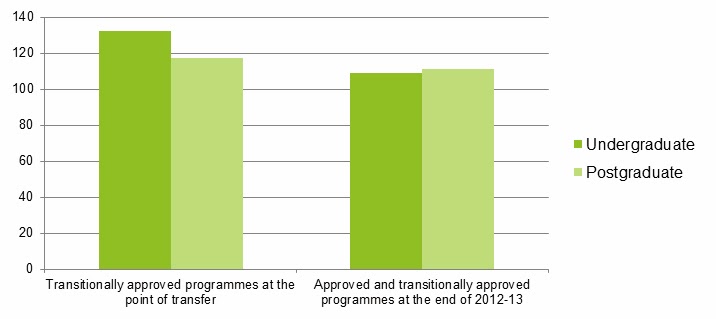
One thing we saw was a twelve per cent reduction in the number of approved and transitionally approved programmes a year after the transfer. Of the 82 education providers running transitionally approved programmes at the point of transfer, 79 continued to deliver social work programmes, with three closing their social work provision entirely. The graph below shows how these closures have affected the split between approved undergraduate and postgraduate programmes over the last year. You can read more about these changes in the full paper, which you can view on our website here.

Comparison of programme numbers at the point of transfer and at the end of the 2012–13 – by qualification level


We also noted that there were significant changes to some programmes in areas such as curriculum design and delivery, and practice placements standards as they adapted to meet our standards, but also due to the recommendations of the Social Work Task Force, including The College of Social Work’s (TCSW) Professional Capabilities Framework.

Our review shows that the approval process was implemented effectively and that we have learned from the recent onboarding of other professions, such as hearing aid dispensers and practitioner psychologists. Specifically, as part of the preparation for the onboarding of the profession, we ensured that we worked closely with TCSW, holding regular meetings and developing a suggested agenda for joint approval / endorsement events.

In the full paper, we have provided detailed analysis about which standards had a higher number of conditions set, and have discussed reasoning for why we needed to set more conditions for these standards. Education providers, in particular those who have yet to have their visit, may find the full report useful in preparing for their own visits.

In particular, we have noted that many conditions were set in several of our broad SET areas, specifically those related to curriculum and assessment (SET 4 and 6), practice placements (SET 5), and programme management (SET 3). However, it is important to note that these are not issues that are specific to social worker programmes in meeting our standards. We expect to see conditions in these areas when onboarding any new profession or visiting new programmes from existing professions.

Number of conditions for social work programmes in 2012–13 – by broad areas of the standards of education and training


Where necessary, programmes have implemented changes to ensure our regulatory requirements are met. This shows that our standards, which are designed to be broad and flexible, can be applied across different professions and education programmes.

All social work programmes that we visited in the 2012-13 academic year have now successfully completed the approval process. The programmes now have ongoing approval confirmed, subject to satisfactory monitoring. We will continue to review the outcomes from our approval visits to social work programmes on a regular basis throughout the next two academic years.

Jamie Hunt
Education Manager
HCPC


Notes:

View the full review paper at www.hcpc-uk.org/assets/documents/100042FESWapprovalreview12-13.pdf

Find out more about our education processes at www.hcpc-uk.org/education/

02 August 2012

The end and the beginning: Social workers in England have a new independent regulator


Yesterday marked the beginning of a new chapter in the regulation of social workers in England. From 1 August, all practising social workers in England have to be registered by the re-named Health and Care Professions Council (HCPC). This follows many months of preparation by HCPC in collaboration with the outgoing regulator, the General Social Care Council (GSCC), to ensure a smooth transfer.

What this change means for all social workers in England is that they are required to sign up to a new set of standards. These describe not only the ethics and conduct of their work, also the knowledge and skills expected of them. The HCPC will also require social workers to sign up to new standards on CPD, which are focused on the outcomes of learning, rather than the hours or points system which social workers have been used to. There will be more of a focus on personal responsibility for undertaking learning activities, and a requirement to undertake a wider range of activities, both formal and informal, which contribute to the process of keeping up to date and fit to practise.

The benefits of this new system of regulation are in part to do with HCPC's legislation. We have a wider range of standards, describing social worker competencies as well as conduct. We have stronger powers for dealing with concerns and complaints, which will make the process of investigation more efficient. We have a broader range of sanctions when dealing with concerns about a social worker’s fitness to practise, for example we can impose conditions on a social workers practise, ensuring that they receive supervision or re-training if their practise falls below our standards.

Taken together, these new standards, powers and sanctions will allow us to protect the public from poor practitioners and affirm the high standards in the profession. However, regulators do not operate in isolation. We will be building on the achievements of GSCC, working with the profession, with professional bodies, service users, advocacy groups and unions, as well as with educators to ensure that registered social workers in England are practising safely and effectively.

Over the last two years I have learned much about social work practise from listening to social workers and service users. Society has high expectations of those who practise as social workers. The work of a social worker is frequently challenging, often complex, and rarely acknowledged. For every one social worker who falls below national standards, there are many hundreds whose commitment and service to children and adults bring lifelong benefits and significant improvements. A huge amount has rightly been invested in the profession in recent years and the work of the Munro team, the Social Work Reform Board, and most recently, the new guidance on safeguarding children and the Social Care White Paper, are all promoting the vision of a stronger, more confident profession for the 21st century. HCPC, as the newly appointed independent statutory regulator of social workers in England, is looking forward to contributing to this vision. We will be working closely with our colleagues in the Care Councils in Scotland, Wales and Northern Ireland, whose experience and insights have already proved invaluable to us.

Yesterday also marked the end of an important chapter in the regulation of social workers. The outgoing regulator, the GSCC, has made a significant contribution to the profession. It established the first statutory register of social workers in England 11 years ago, developed the first standards and redefined the entry requirements for education. Perhaps most significantly, GSCC was far sighted in its approach to involving service users in decision making. Their legacy work on ensuring that the lessons learned during this important period will be disseminated and carried forward have been very well received, and will continue to influence social work practise into the next decade and beyond.

On behalf of HCPC, I would like to thank the Council and Executive at GSCC for working with us over many months, and pay tribute to their professionalism and commitment.

Anna van der Gaag

Chair


16 July 2012

Standards of proficiency for social workers in England

On 1 August 2012 we will take over the regulation of social workers in England from the General Social Care Council (GSCC) which closes on 31 July 2012.


The preparations for this transfer are almost complete and last month, we published our standards of proficiency (SoPs) for social workers in England. The standards of proficiency set out what a social worker in England should know, understand and be able to do when they complete their social work training so that they can register with us. They set clear expectations of a social worker’s knowledge and abilities when they start practising.

We will use these standards when we approve undergraduate degree and masters degree programmes in social work to make sure that someone who successfully completes their degree has met the standards they need to practise safely and effectively as a social worker. We also use these standards to assess applications to join the Register from individuals who have qualified outside the UK.

We know that once a social worker becomes registered their practise might develop in lots of different ways – for example, they might work in different settings, specialise in a particular area of practise or become involved in training social work students. Because of this, once a social worker is registered with us we will expect them to continue to meet the standards of proficiency, but only those that continue to apply to their particular scope of practice.

The standards of proficiency include standards about ethics, communication skills, team working and safeguarding vulnerable people. Some examples of these standards are listed below:

• be able to undertake assessments of risk, need and capacity and respond appropriately

• be able to recognise and respond appropriately to unexpected situations and manage uncertainty

• be able to recognise signs of harm, abuse and neglect and know how to respond appropriately

Social workers in England will also have to meet the standards of conduct, performance and ethics. These standards set expectations in terms of ethics and behaviour and they are similar to the GSCC’s Code of Practice.

Our work to set the standards of proficiency took place whilst the Social Work Reform Board, and subsequently The College of Social Work, developed the Professional Capabilities Framework (PCF) for social workers. The PCF supports social workers throughout each stage of their career, beyond the threshold standards we set. The PCF acts as an overarching framework by setting out key capabilities expected of a social worker as they develop in their career. These include professionalism, values and ethics, knowledge, intervention and skills and professional leadership.

Whilst the PCF looks across a social worker’s career, from before they start their training to the very end, the standards of proficiency set out our expectations of social workers when they start practising for the first time.

We consulted on the standards of proficiency last year. Some respondents to the consultation asked about the interactions between the SoPs and the PCF and wanted more clarity on the different roles. Consultations are an important way of engaging with stakeholders and we made a number of changes to the standards following feedback from the consultation.

However, we also wanted to respond more generally to the comments about the interactions between the SoPs and the PCF. As a result, we have worked with The College of Social Work to produce a joint statement setting out the different, but complementary, roles of the SoPs and the PCF. We have also worked to produce a joint mapping of the SoPs to the PCF level of end of last placement.

The GSCC have published several reports setting out their experience of regulating social workers. In the report ‘Regulating social workers 2001 – 2012’, they say that they believe that the SoPs and the PCF are ‘significant improvements on the GSCC codes of practice for the specific regulation of social workers’.

Setting effective standards is an important part of our role in protecting the public. We are committed to working alongside the social work community to raise standards and achieve the vision of a safe, confident future for social work.

For more information please visit our website

By Charlotte Urwin, Policy Manager at the Health Professions Council (HPC)*

*From 1 August 2012, HPC will regulate social workers in England. At that time, we will be renamed the Health and Care Professions Council to reflect our new remit and the diverse range of professions on our Register.


20 June 2012

Student fitness to practise: Finding a proportionate way forward


In recent months, we have been examining the most appropriate mechanism for assuring the fitness to practise of students during their education and training. We have undertaken this work because the General Social Care Council (GSCC), the current regulator of social workers in England, holds a register of social work students, as do the other Social Work Regulators in Scotland, Wales and Northern Ireland. In contrast, we do not hold a student register. Instead, we assure the fitness to practise of students through our standards of education and training and the approval of education and training programmes.

We consulted between November 2011 and March 2012 on whether or not a register for student social workers in England should be held by HPC, and whether or not a student register should exist for the 15 professions we currently regulate. We also commissioned an independent literature review.

 
It was clear from the literature review that student registers are the exception, rather than the norm in professional regulation, both in the UK and elsewhere. Other mechanisms, such as robust standards for educators and placement supervisors, well executed student fitness to practise processes, and holding students to account through standards and guidance on conduct are more commonly used. The review also highlighted the need to educate students about their responsibilities as professionals in training.

In the consultation the majority of those who responded from the social work community thought that registration of social work students should continue. Registration was seen as helpful in providing a ‘safety net ‘ which ensured that consistent decisions were made about the suitability and conduct of students. This was often considered useful in providing additional reassurance to employers accepting students on practice placements.

However, we also heard concerns from social work employers and other stakeholders about some of the current supervision arrangements for social work students on practice placements and in particular, about social work students’ unsupervised contact with vulnerable service users whilst on placement. In contrast, the majority of professions currently regulated by HPC did not think a student register was appropriate, considering that these issues were best managed by education providers in accordance with our standards, assured through our programme approval arrangements.

It seems clear from the consultation that whatever stakeholders’ views on registration, we all want to achieve the same outcome – students who understand the professional responsibilities expected of them and who are fit to practise and equipped to work with service users when they complete their training.

We recently looked at the results of the consultation and the evidence from the review and decided that there should be no new register for the 15 professions we currently regulate. We also agreed that, in the longer term, the most effective and proportionate means of quality assuring the fitness to practise of student social workers in England would be through the HPC’s existing mechanisms. (To read my Guardian article on this click here)

After the register of social workers in England opens in August 2012 education providers will have to meet our standards of education and training. At this time, all the programmes approved by the GSCC will be treated on a transitional basis as if they were approved by us and we will begin scrutinising those programmes to ensure that our standards are met.

These standards will ensure that social work education providers retain overall responsibility for their programmes, including owning and managing the potential risks associated with the character and conduct of students. For example, education providers are required to have arrangements in place for dealing with concerns about students on placements; and have arrangements in place for managing and monitoring practice placements effectively, including ensuring that students receive appropriate supervision and that there is effective partnership working with employers. They also ensure that students understand their obligations under our standards of conduct, performance and ethics.

Many education providers are likely to already meet these requirements. However, we know that the Social Work Task Force  has previously reported continuing concerns about some social work practice placements, so some providers may well find the new requirements challenging to meet.

In our discussions, we were mindful of the potential impact that not registering social work students and applying our standards might have on social work education providers and employers. The Council therefore decided that it would be preferable to introduce interim arrangements over the next two to three years whilst the approval of programmes takes place.

At our meeting on 19 June 2012, we agreed to implement a new process for dealing with concerns about student fitness to practise - a social work student suitability scheme. The key features of this scheme are:

  • There is no HCPC register of all social work students
  • There is a mechanism for referral to us where,
    • in exceptional circumstances, an education provider requires an opinion on whether an applicant is of suitable character to be admitted to a programme.
    • a student has been removed from a programme or has withdrawn from a programme following a complaint
    • an education provider has not dealt with a credible complaint appropriately.
  • Students who have complaints upheld via the scheme may be placed on a list which would prevent them from being admitted to, or participating in, a social work programme.

 The scheme has several benefits. It provides a transitional ‘safety net’ of a kind that social work stakeholders have suggested is necessary. It will allow educators, employers, colleagues and members of the public, to refer their concerns to the regulator during the transition to HCPC standards. It is proportionate, in that it only affects those students and prospective students who are a cause for concern. It will send a clear message to educators that they are responsible for ensuring that student fitness to practise is managed and quality assured according to HCPC standards.


We have listened to the concerns expressed by social work stakeholders, and we are conscious of the huge changes that are underway in the social work profession. Our aim is to work with the social work community to drive up standards. HPC has a good track record in quality assuring education and training programmes through its standards of education and training and approvals process. Ultimately, these standards will apply across all social work programmes. But this will not happen overnight. The suitability scheme does not compromise the role or purpose of HPC’s standards, but does provide a proportionate mechanism to mitigate risk and allow time for change.


 Anna van der Gaag

Chair