Showing posts with label social workers. Show all posts

18 November 2013

A look back at the first year of social work programme approvals

When the Register for social workers in England opened on 1 August 2012, we became responsible for the 249 pre-registration social work programmes that had previously been approved by the General Social Care Council (GSCC). To ensure these programmes meet our standards of education and training (SETs), we will visit each of these programmes to confirm their approval.

We held the first year of these approval visits during the 2012–13 academic  year and will continue with the visits for another two years As with all professions new to the HCPC, we have completed a review of this first year of approval visits to social work programmes.

Considering the other recent, non-regulatory changes in the social work education sector, we expected there would be significant changes to education providers’ social work provision.

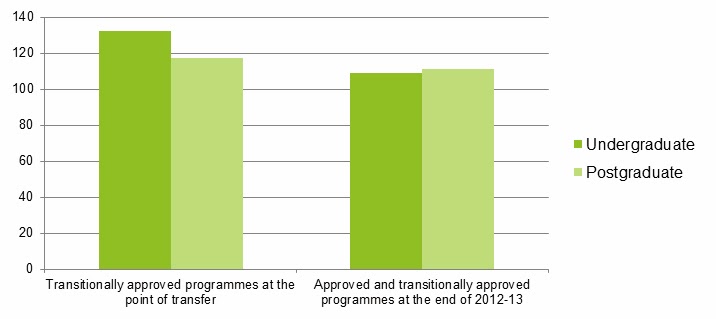
One thing we saw was a twelve per cent reduction in the number of approved and transitionally approved programmes a year after the transfer. Of the 82 education providers running transitionally approved programmes at the point of transfer, 79 continued to deliver social work programmes, with three closing their social work provision entirely. The graph below shows how these closures have affected the split between approved undergraduate and postgraduate programmes over the last year. You can read more about these changes in the full paper, which you can view on our website here.

Comparison of programme numbers at the point of transfer and at the end of the 2012–13 – by qualification level

We also noted that there were significant changes to some programmes in areas such as curriculum design and delivery, and practice placements standards as they adapted to meet our standards, but also due to the recommendations of the Social Work Task Force, including The College of Social Work’s (TCSW) Professional Capabilities Framework.

Our review shows that the approval process was implemented effectively and that we have learned from the recent onboarding of other professions, such as hearing aid dispensers and practitioner psychologists. Specifically, as part of the preparation for the onboarding of the profession, we ensured that we worked closely with TCSW, holding regular meetings and developing a suggested agenda for joint approval / endorsement events.

In the full paper, we have provided detailed analysis about which standards had a higher number of conditions set, and have discussed reasoning for why we needed to set more conditions for these standards. Education providers, in particular those who have yet to have their visit, may find the full report useful in preparing for their own visits.

In particular, we have noted that many conditions were set in several of our broad SET areas, specifically those related to curriculum and assessment (SET 4 and 6), practice placements (SET 5), and programme management (SET 3). However, it is important to note that these are not issues that are specific to social worker programmes in meeting our standards. We expect to see conditions in these areas when onboarding any new profession or visiting new programmes from existing professions.

Number of conditions for social work programmes in 2012–13 – by broad areas of the standards of education and training


Where necessary, programmes have implemented changes to ensure our regulatory requirements are met. This shows that our standards, which are designed to be broad and flexible, can be applied across different professions and education programmes.

All social work programmes that we visited in the 2012-13 academic year have now successfully completed the approval process. The programmes now have ongoing approval confirmed, subject to satisfactory monitoring. We will continue to review the outcomes from our approval visits to social work programmes on a regular basis throughout the next two academic years.

Jamie Hunt
Education Manager
HCPC


Notes:

View the full review paper at www.hcpc-uk.org/assets/documents/100042FESWapprovalreview12-13.pdf

Find out more about our education processes at www.hcpc-uk.org/education/

23 April 2012

Service user involvement in the design and delivery of approved programmes

In 2011, we asked researchers at Kingston University and St George’s (University of London) to undertake some research for us looking at the involvement of service users in the design and delivery of education and training programmes approved by the HPC. The research included a literature review; a survey of education providers; and focus groups with students, educators and service users. The final research report is now available to download from our website. I would like to thank all the educators, service users and students who participated in the research.
Most previous research on this topic is about medicine, nursing and social work education, so we hope that this work will make a positive contribution to this area. The research should be useful for education providers thinking about how they might involve service users in their programmes.

Q. Why did we commission research in this area?

Our standards of education and training guidance already encourage education providers to provide evidence of service user involvement in their programmes. However, involvement is not currently an explicit part of the standards, so it is possible we could approve a programme which did not involve service users at all.

In August 2012 we will become responsible for regulating social workers in England. Service user and carer involvement is a particular focus in social work education. There are existing regulatory requirements that service users and carers should be involved in all aspects of social work programmes – including in selection, teaching, assessment and quality assurance.

We have been considering whether we might strengthen our requirements in this area by amending our standards of education and training to require service user involvement for a programme to be approved with us and commissioned the research to help us in making that decision. We wanted to find out more about good practice in involving service users in education and training programmes; the extent and types of involvement activities already undertaken by education providers whose programmes we approve; and to learn more about the drivers, benefits and challenges of involving service users.
 
Q. What were the research findings?

There were no programmes that did not involve service users in some way in how they were designed (e.g. monitoring and evaluation of programmes) and/or delivered (e.g. selection, teaching, assessment). Service user involvement was most common in the area of programme planning. There were no notable trends between different professions or between different types of programme or education provider.

Most involvement activity is piecemeal rather than systematic. There was limited evidence to demonstrate a clear, causal link between service user involvement and outcomes such as improvements in the quality of treatment and care. However, overall, the research indicated that service user involvement is likely to, or is perceived to have a number of positive effects, including programmes which better reflect the needs and wishes of users of services, resulting in practitioners who are able to involve service users in decisions about their care or services.
One challenge was the definition of service users. A variety of different potential service users were identified, including patients, clients, carers and colleagues. The term was used differently in the literature and by stakeholders involved in the research and it was acknowledged that some professions do not have direct patient or client facing contact. The term ‘end recipient of a service’ was suggested as a means to define the scope of the term. A variety of facilitators and barriers to involvement were identified including funding, leadership and the representativeness and vulnerability of service users. There was general support for amending the standards of education and training, with some caveats and concerns about the need for a standard; the scope of the standard; and the practicalities of meeting it.

Q. What have we concluded?

The research was discussed by our Education and Training Committee at its meeting in March 2012. The Committee agreed that service user involvement in approved programmes was important and, in principle, that an additional standard of education and training could act as a driver for education providers to involve service users in their programmes, sending out a strong message that service user involvement is important for public protection.

The research revealed general support for a standard but with some concerns and caveats. We want to develop a proposed standard which is enabling and meaningful. It needs to be applicable across the diversity of professions and programmes we approve, allowing for flexibility whilst setting an appropriate threshold benchmark for all.

If we were to agree a new standard, we would propose that education providers should have a longer than normal lead-in period so that we can communicate our requirements clearly to education providers, for example, via ‘Education update’ and in our annual seminars with education providers. This will also allow education providers the time to make any changes to their programmes which might be necessary.

Q. What happens next?

We will be considering the wording of a proposed standard and supporting guidance at our next Education and Training Committee meeting in June 2012. Subject to Committee and Council approval, we currently anticipate that a public consultation on the proposed standard and guidance might take place from September 2012.

Michael Guthrie
Director of Policy and Standards
HPC

27 February 2012

Student fitness to practise and registration – consultation ends 2 March 2012

Q. What risks do students training to be health and care professionals pose to the service users they come into contact with?

Q. How effectively do education providers deal with cases of poor conduct by students?

Q. How can we best make sure that students understand the responsibilities of them as future registrants?

Q. Should social work students (in England) continue to be registered?

These questions and more are discussed in our on-going consultation looking at student fitness to practise and registration.

We are seeking the views of all of our stakeholders on the most effective way of assuring the fitness to practise of students, including the registration of social work students in England. The consultation is being held partly because we will become responsible for regulating social workers in England from 1 August this year. Social work students are required to register with the General Social Care Council (GSCC) but the HPC does not currently register students.

Alongside the consultation, we also asked some researchers to undertake a review of the published literature in this area. This was so that we could build an increased understanding of the levels of risk from students in each of the 15 professions we regulate, and in social work, and benefit from any evidence about the best ways in which that risk might be managed. We will consider the research alongside the responses to the consultation.

The launch of the consultation prompted a renewed debate amongst the professions about the best way of managing student fitness to practise. In the social work field, Community Care reported on the potential costs if social work students continued to be registered. The General Social Care Council (GSCC) argued that registration of student social workers was crucial, in order to ‘uphold standards’ and because of the ‘unique risks associated with practice placements’.

In the consultation we have not made any specific proposals – for example, we have not proposed that social work students should or should not be registered. Instead, we wanted to stimulate discussion amongst all the professions on this topic, to help us reach an informed view on the best approach to take. So it is encouraging to see that in the professional press, in the conversations I have had with a wide range of stakeholders since we launched the consultation, and in the responses to the consultation we have received so far, we are hearing a wide range of different perspectives on this issue.

The consultation closes on 2 March 2012 and I would encourage anyone with an interest in this area to let us know what they think here.

Michael Guthrie
Director of Policy and Standards

Health Professions Council

14 October 2011

Standards of proficiency for social workers in England: Reflecting the complexity of social work practice


As you may be aware, next year the regulation of social workers in England is due to transfer from the General Social Care Council (GSCC) to the Health Professions Council. We are also due to be renamed the Health and Care Professions Council to reflect our new role. As part of getting ready for the transfer, we are currently consulting on standards of proficiency for social workers in England.

Each profession regulated by the HPC has their own specific standards of proficiency and this is a legal requirement. The standards of proficiency will set out what a social worker needs to know about, understand and be able to do when they become registered for the first time.

We will use these standards when we approve undergraduate degree and masters degree programmes in social work to make sure that someone who successfully completes their degree has met the standards they need to practise safely and effectively as a social worker.

We know that once a social worker becomes registered their practise might develop in lots of different ways – for example, they might work in different settings, specialise in a particular area of practise or become involved in training social work students. Because of this, once a social worker is registered with us we will expect them to continue to meet the standards of proficiency, but only those that continue to apply to their particular scope of practice.

The draft standards of proficiency include standards about ethics, communication skills, team working and safeguarding vulnerable people. Some examples of these standards are listed below:

• knowing the limits of practice and seeking advice or referring to another professional where appropriate
• recognising workload and resources
• understanding the importance of maintaining their own health and wellbeing
• Being aware of the characteristics and consequences of verbal and non-verbal communication and how this can be affected by disability, culture, age, ethnicity, gender, religious beliefs and socio-economic status.
• Being able to contribute effectively to work undertaken as part of a multi-disciplinary team.

These are just a few examples. We set up a working group involving key stakeholders from social work to help us to put together the draft for consultation

The standards play a specific and important role in how we regulate but very much complement other standards such as the Professional Capabilities Framework (PCF). We have written a short statement with the Social Work Reform Board setting out the role of the standards of proficiency and the PCF
http://www.hpc-uk.org/mediaandevents/statements/hpcandswrbjointstatement/

Currently social workers have to meet the GSCC’s code of practice for social care workers and our standards of conduct, performance and ethics (SCPE) will replace this code. These standards describe how the public and professionals alike expect someone who is registered with us to behave. They include standards such as the need to act in the best interests of service users, protect confidentiality and behave with integrity and honesty. The standards apply to all of the 15 professions we currently regulate and once social workers in England join the HPC register they will also have to meet these. Next year, we plan to review these standards so there will be an opportunity for social workers to help us shape these standards for the future.

We are really keen to hear what social workers and others think about the draft standards. It provides a great opportunity for individual social workers to get involved and to help us to make sure the standards are fit for purpose and reflect the values and context of social work.

The consultation closes on 18 November 2011. Please do respond and help us in shaping these important standards for social workers.

Link to the consultation:

http://www.hpc-uk.org/aboutus/consultations/

Link to our standards of conduct, performance and ethics
http://www.hpc-uk.org/aboutregistration/standards/standardsofconductperformanceandethics/


By Michael Guthrie
HPC's Director of Policy and Standards

12 April 2011

New Standards of Proficiency for social workers in England: Reflecting the complexity of social work practice

Many people will be aware that the Government has proposed to transfer responsibility for the regulation of social workers in England to the HPC. As part of the preparations for this transfer, we established a working group (known as a Professional Liaison Group) of experts in the field of social work to assist us with the drafting of new standards of proficiency for social workers in England. This group met for the last time this week, having met four times since November.

The purpose of the standards of proficiency is to establish threshold standards necessary for safe and effective practice. They must reflect existing requirements and training provision, and must be flexible enough to apply to the different environments in which social workers practise. Each profession regulated by HPC has developed standards, written as part of the overarching standards which apply to all. This is a legal requirement, and the standards are specified in the legislation, which is why they had to be developed in addition to existing frameworks and standards, such the Professional Capabilities Framework or the National Occupational Standards. The HPC standards of proficiency serve a particular purpose – they are threshold standards for safe and effective practise for social workers in England – and although they do relate to the existing frameworks they have to be created for each profession regulated by HPC.

The key challenge is to ensure that the standards reflect the values of social work, the complexity of practice and diversity of contexts and settings in which social workers find themselves.

The process of drafting standards requires individuals who are able to focus on the nuances of the meaning of a sentence whilst holding the big picture of what lies at the heart of social work practice. Over the years I have taken part in many PLG meetings at HPC. I have rarely seen a group work so well together so quickly on what is ahugely challenging task. The representatives from the social work community included social work managers, employers, academics, professional body, regulatory body and union representatives. The group was well chaired by Professor Jeff Lucas, a lay member of the HPC Council and included three Members of the HPC Council. The feedback from members on the process and the way it was conducted by the HPC Executive was positive and constructive.

The next step is to ensure that the standards are thoroughly reviewed by a wide range of stakeholders before being approved by the HPC’s Education and Training Committee and Council. Once published, the standards will be subject to ongoing reviews and updates to ensure that they continue to develop and change with the profession. There is more work to be done in ensuring that the standards are clearly situated within existing standards and frameworks for social workers in England, and that the relationships between these different standards and their particular purpose is clearly understood. I have no doubt that the collaborative spirit in which this first stage has been conducted will continue to influence the process as it unfolds, and I am grateful to all those who have taken the draft standards thus far. The beginning is always the hardest part.

Anna van der Gaag
Chair
HPC