Showing posts with label regulation. Show all posts

20 November 2013

Understanding Public Protection

Because the fitness to practise is such an important part of the work we do to protect the public, it is an area we are constantly trying to increase our understanding of and a process we are always reviewing.

Research

One important way we do this is through research. Today, we have released the data from our latest study, which shows that a fifth of UK adults have encountered behaviour from a health or care professional that made them doubt their fitness to practise.

The research also found:
  • More than a quarter said the health or care professional in question seriously or persistently failed to meet standards.
  • 16 per cent said they felt the professional failed to respect the rights of a patient to make their own choices. 
  • 13 per cent felt they were ‘hiding mistakes’.
  • 9 per cent felt they were exploiting vulnerable patients. 
  • One in twenty said they had experienced or witnessed reckless or deliberately harmful acts.
Despite these figures, just three out of ten reported their concerns and a further 73 per cent said they would not know where to go to report concerning behaviour.
 
This data supports our research published earlier this year exploring public perceptions of the concept of public protection and how this might inform the fitness to practise of health and care professionals. That research showed that the public was most concerned about dishonesty, both on and off duty, and had an expectation that, at a minimum, professionals would be competent and qualified.  Importantly, the public also thought that judgements should always consider the context of a situation and be made on a case-by-case basis.
 
The findings of both research reports are reassuring because we are dealing with the areas the public feel they need protecting from the most – skills and behaviour – and support the case-by-case approach we already take fitness to practise. See our latest annual report and key information for a look at what we have been doing over the past year to protect the public.
 
Improving the FTP process
 
In addition to making interesting reading for professionals and regulators alike, the findings of the research are helping us in a broader piece of work to improve the FTP process for all concerned, for example reviewing the information we provide about the process.
 
Earlier this year, we held an event with representatives from stakeholder organisations, including professional bodies, to discuss the research on public protection and explore how we can continue to do this. Some key themes emerged from the discussions. These included:
  • More and clearer information for employers and registrants explaining the difference between the FTP and other disciplinary or criminal proceedings.
  • Case studies indicative of FTP cases that could be used as learning and discussion points.
  • Clearer information for service users about what an FTP case looks like to help manage expectations on what we can and cannot deal with, as well as support and clear signposting for service users when they have a concern that is not a FTP issue.
  • Better integrated and more interactive information, including cross-referencing exiting documents and more video and multimedia content.
We will be looking at both the research and the feedback we have received so far as we continue our review of the FTP experience.

Brian James
Head of Assurance and Development, Fitness to Practise

Notes:
- Today's research release
- Understanding public protection research, 2013

18 November 2013

A look back at the first year of social work programme approvals

When the Register for social workers in England opened on 1 August 2012, we became responsible for the 249 pre-registration social work programmes that had previously been approved by the General Social Care Council (GSCC). To ensure these programmes meet our standards of education and training (SETs), we will visit each of these programmes to confirm their approval.

We held the first year of these approval visits during the 2012–13 academic  year and will continue with the visits for another two years As with all professions new to the HCPC, we have completed a review of this first year of approval visits to social work programmes.

Considering the other recent, non-regulatory changes in the social work education sector, we expected there would be significant changes to education providers’ social work provision.

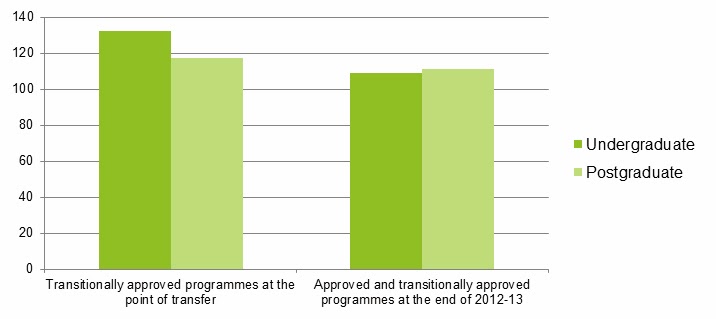
One thing we saw was a twelve per cent reduction in the number of approved and transitionally approved programmes a year after the transfer. Of the 82 education providers running transitionally approved programmes at the point of transfer, 79 continued to deliver social work programmes, with three closing their social work provision entirely. The graph below shows how these closures have affected the split between approved undergraduate and postgraduate programmes over the last year. You can read more about these changes in the full paper, which you can view on our website here.

Comparison of programme numbers at the point of transfer and at the end of the 2012–13 – by qualification level


We also noted that there were significant changes to some programmes in areas such as curriculum design and delivery, and practice placements standards as they adapted to meet our standards, but also due to the recommendations of the Social Work Task Force, including The College of Social Work’s (TCSW) Professional Capabilities Framework.

Our review shows that the approval process was implemented effectively and that we have learned from the recent onboarding of other professions, such as hearing aid dispensers and practitioner psychologists. Specifically, as part of the preparation for the onboarding of the profession, we ensured that we worked closely with TCSW, holding regular meetings and developing a suggested agenda for joint approval / endorsement events.

In the full paper, we have provided detailed analysis about which standards had a higher number of conditions set, and have discussed reasoning for why we needed to set more conditions for these standards. Education providers, in particular those who have yet to have their visit, may find the full report useful in preparing for their own visits.

In particular, we have noted that many conditions were set in several of our broad SET areas, specifically those related to curriculum and assessment (SET 4 and 6), practice placements (SET 5), and programme management (SET 3). However, it is important to note that these are not issues that are specific to social worker programmes in meeting our standards. We expect to see conditions in these areas when onboarding any new profession or visiting new programmes from existing professions.

Number of conditions for social work programmes in 2012–13 – by broad areas of the standards of education and training


Where necessary, programmes have implemented changes to ensure our regulatory requirements are met. This shows that our standards, which are designed to be broad and flexible, can be applied across different professions and education programmes.

All social work programmes that we visited in the 2012-13 academic year have now successfully completed the approval process. The programmes now have ongoing approval confirmed, subject to satisfactory monitoring. We will continue to review the outcomes from our approval visits to social work programmes on a regular basis throughout the next two academic years.

Jamie Hunt
Education Manager
HCPC


Notes:

View the full review paper at www.hcpc-uk.org/assets/documents/100042FESWapprovalreview12-13.pdf

Find out more about our education processes at www.hcpc-uk.org/education/

17 July 2013

What is the opposite of competence?


One of the key responsibilities of a professional regulator is to ensure that professionals are competent when they join the register and remain competent throughout their working lives. HCPC sets standards of competence (called proficiency) to do just this, and at the moment we are in a phased review of these for 15 out of 16 of the professions we regulate. This involves extensive review, consultation and further revisions in order to ensure that the standards remain fit for purpose and up to date. Good regulation depends first and foremost on having robust and credible standards which reflect professional practice in meaningful ways.  

 However, there is much more to maintaining competence than good standard setting. More than twenty years ago, I worked on a research project looking at the nature of professional competence in my own profession. Phil Davies and I published a series of papers describing in some detail the methodology and results of this work (1). We observed that competence is always more than the sum of its parts, and it is often if not always context sensitive – that is, influenced by the context in which practice plays out. It is also as much about the underlying values of the practitioner as it is about the ‘technical’ knowledge and skills.

 I was therefore particuarly pleased to attend a lecture  in Edinburgh last month which reinforced some of these points, taking a fresh look at competence from the perspective of the onlooker (2). Professor Zubin Austin from the University of Toronto described how a patient or service user’s perspective on competence will differ from an educational or a legal or a  professional perspective. Patients and service users want accessibiity, affability and acknowledgement. They want kindness as well as knowledge. There has been much to reinforce this in the recent debates about the training and supervision of care assistants (3).

 Perhaps the most potent point Zubin made was that, in his view, the opposite of competence is not incompetence, but disengagement. Professionals become disengaged, not deliberately or suddenly, but incrementally and often in ways that go unnoticed for months or even years. The events in Mid-Staffordshire would seem to support this, too. 

 The challenge for us all is how do  we address this engagement issue? How do employers, educators, peers and regulators work together to help individuals to stay connected? Zubin’s assertion is that systems and relationships need to reinforce good behaviours not just focus on bad behaviours. Think of competency in a different way.

 
Anna van der Gaag
Chair
HCPC


NOTES

(1) van der Gaag, A. Davies, P. (1992).The professional competence of speech therapists: IV: Attitude and attribute base. Clinical Rehabilitation 6,4, 325-332.

 (2) Austin Z. (2013) How competent are we at assessing competency?

Keynote, CLEAR Congress on Professional and Occupational Regulation, Edinburgh, June 27-28,  2013 www.clearhq.org

(3) Cavendish C. (2013) What the NHS needs is a degree of kindness.The rest can be taught. Sunday Times, 14.7.13.

28 May 2013

Education annual report 2012


Our Education Department approves and monitors education and training programmes throughout the UK. This relates predominantly to pre-registration programmes for the 16 professions we regulate, although we do also approve a small number of programmes linked to post-registration areas of practice. Our standards of education and training (SETs) ensure that a programme that maintains its approval with us produces individuals who are fit to practice and are therefore eligible to apply to our Register.

We published the Education annual report 2012 on Tuesday 7 May 2013. Here, we look at some of the key themes from our review of our approval and monitoring activities across the UK during the 2011-12 academic year.

In numbers
During this period we:
  • conducted 67 approval visits assessing 110 programmes;
  • reviewed 256 annual monitoring declarations and 221 annual monitoring audit submissions;
  • considered 316 major change notifications;
  • investigated four concerns raised about approved programmes that were within our remit; and 
  • transferred 269 social work pre-registration programmes and 27 approved mental health professional (AMHP) programmes to our register of approved education and training programmes following the transfer of social workers in England from the General Social Care Council on 1 August 2012.
The video below provides a brief overview of key facts and figures from this year's report:


Conditions for new programmes
A key area of growth over the last three years related to new programmes for practitioner psychologists and hearing aid dispensers following the opening of these Registers in July 2009 and April 2010 respectively. We concluded the schedule of approval visits to these programmes in summer 2012.

A common theme across these programmes was the number of conditions we applied on approval that related to practice placements. Our SETs require an education provider to hold overall responsibility for placement provision. Conditions in this area are therefore often focused on the quality assurance arrangements the education provider has in place to manage these important areas of teaching and learning.

This is a trend we often see with new profession programmes that transfer over to us and with new programmes from our existing professions. Our Visitors normally ask for further evidence that education providers are well placed to manage practice placements and that placement educators are equipped to provide appropriate learning experiences. This often means education providers must demonstrate that there are formal, documented arrangements underpinning the relationships they have with their placement providers. When considered in this context, these results do not suggest any profession-specific risk profile for either new profession.

To help address this across all professions, we have been delivering seminars for the past two academic years that are focused on supporting education providers in their management of placements. For these seminars, we invited both education providers and placement educators to attend as we recognise the important role they each play in ensuring the education experience meets our standards. These seminars were well attended by representatives from the majority of our professions and facilitated useful discussions about different approaches to the management of placement provision.

The MSC initiative
The Modernising Scientific Careers (MSC) initiative – a workforce strategy from the Department of Health – has also had an impact on education programme numbers, with the creation of 16 new biomedical scientist programmes in 2011-12, which we approved. We also approved a new route to registration for clinical scientists modeled against the new MSC scientific training pathway. It is possible that we may see the creation of more new biomedical scientist and clinical scientist programmes in future years as a result of the MSC initiative.

These developments suggest that our standards remain fit for purpose and can be appropriately applied to a range of professions and models of education and training for the professions we regulate.

Monitoring
When compared over the last five years, it is clear that our monitoring workload is growing. For annual monitoring, we have seen an increase of 85 per cent between 2007-08 and 2011-12. Major change notifications also increased by 32 per cent in the 2010-11 academic year. These increases are expected each year, because as we approve more programmes, more programmes are subject to meeting our monitoring processes. We anticipate further growth as practitioner psychologist and hearing aid dispenser programmes move into our monitoring cycle.

We required additional documentation for 41 per cent of annual monitoring audit submissions. This is comparable with the results from last year, which reflects the requirement for education providers to show how they meet the revised SETs implemented in September 2009. All programmes in the annual monitoring cycle have now provided this evidence and we expect the number of requests for additional documentation to fall again next year accordingly.

No programmes required a further approval visit as a result of an audit submission and only 2 programmes required a further approval visit as a result of a major change submission.  We only decide to conduct an onsite approval visit when the changes submitted by an education provider have significantly changed the way their programme meets our standards. Pleasingly, these results mean our model of open-ended approval is achieving the task it was set out to do: preventing the need for cyclical re-approval visits where possible.

Looking ahead
We anticipate the majority of our approval and monitoring work over the next three academic years to be focused on the schedule of visits to social work and approved mental health professional (AMHPs) programmes in England.

As with all new professions, we will undertake a review of these visits each year to inform our own approval and monitoring approach for these professions and the application of our standards. This review will also feed into future seminar topics and stakeholder liaison that we conduct with the social work profession.

Brendon Edmonds
Acting Director of Education, HCPC

Notes:

You can download a copy of the full Education annual report 2012 here: www.hcpc-uk.org/publications/reports

Further information on the HCPC’s approval and monitoring activities can be found here: www.hpc-uk.org/education

All programmes approved by the Education and Training Committee for meeting our SETs appear on our register of approved programmes: www.hcpc-uk.org/education/programmes/register

07 May 2013

Don Berwick: a challenging voice from the US

The government has published its initial response to the Francis Report, with a wide range of proposals to take the recommendations forward (1).  

Amongst the many initiatives, Professor Don Berwick, a veteran of the healthcare quality movement in the US and former adviser to President Obama, has been invited to report on ‘a whole system approach to make zero harm a reality in the NHS’ (1).  

For over twenty years, Berwick has been a leader in the field of health improvement, looking at how services can improve to make care better, safer and more efficient. His work at the Institute of Health Improvement has made a major contribution to understanding quality and safety in health care.

At a recent lecture at the Kings Fund in London (2), Berwick suggested that the UK health and social care system, like the US system, needed radical solutions if we are to achieve ‘better care, better health and lower cost’. Besides the economic pressures, which are considerable, he talked about the public and the professions being ‘confused’ about what the future of health care delivery would look like. Patients and their carers worry that changes will mean a loss of services, and the professions are unsure about what kind of practice they will have in the future. At a political level, in the US at least, Berwick spoke of a loss of authentic dialogue about exactly what changes will deliver better outcomes.

A quietly spoken man with a powerful combination of conviction and experience, Berwick’s vision had a moral dimension – with a challenge to professionals to focus on the needs of the vulnerable in society. He suggested that, in the future, care must be less centred on hospitals, and be much more community based. He saw the future of care delivered in teams made up of individuals with ‘an expanding scope of practice’, able to meet the needs of local populations, using new technologies and advocating a new approach to involving service users in the decisions about their own care.

Berwick illustratated his vision with examples of innovative care in the US,  many of these based on integrated teams, with little or no heirarchy, and much less doctor-focused than our current systems advocate. He said the first rule of change is to cooperate. The training of health care professionals  must include ‘process improvement, courage, transparency and openess and above all cooperation’.

These are huge ideas, and huge challenges, but arguably they articulate what many people in the UK already recognise.  When HCPC was established over 12 years ago, there was resistance to the idea of an integrated system of professional regulation – where all professions were subject to the same regulatory processes, one register, one fitness to practise process, shared standards and one Board with oversight of all.

Today, the HCPC is seen as an effective and efficient regulator of 16 health, psychological and social work professions. It may well be a model for the future which Berwick describes.
 
Anna van der Gaag
Chair
HCPC

Notes
1)    Department of Health (2013) Patients first and foremost: the intial government response to the Report of the mid Staffordshire NHS Foundation Trust Public Inquiry
2)    Don Berwick (2013) The role of clinical leaders. Kings Fund lecture, 16 April 2013. www.kingsfund.org.uk

11 March 2013

Cab drivers and care workers


The recent King’s Fund conference on the Francis Report has generated considerable debate and discussion, not least because Robert Francis was present to make some powerful observations on the challenges that lie ahead.

One of the areas that was addressed by many of the speakers was around future plans for healthcare support workers. During one of the sessions, we heard about a new approach to recruitment and retention of these staff. Lucy Connolly, Assistant Chief Nurse at York NHS Trust, described how the Trust had moved from a competency based approach in the recruitment of support workers to a values based approach. This includes a person specification with a primary emphasis on values, mandatory open events, which include talks from support workers and a DVD of interviews with support workers talking candidly about the role, and interviews with an emphasis on values and compassion. Once appointed, all support workers undergo a two-week induction, again with an emphasis on values and personal responsibilities. There is a year-long period of preceptorship with a competency assessment, and a buddy scheme to provide more informal support and mentoring. The new approach has had a measurable impact on sickness levels and staff turnover. There has been less reliance on temporary staff and a reduction in recruitment costs. Perhaps most importantly, there has been improvement in care indicators from patients.

This approach reinforced messages from other speakers at the conference about the need to make radical changes in the culture of the NHS. Some of this starts with the recruitment of staff. Francis himself placed great emphasis on the need to change values and behaviour and to reward good practice. However, he also very strongly supported the need for sanctions against those who do not deliver, be they boards, managers or staff. There are a minority of workers in every health and care setting who do not comply. The emphasis on values and behaviour, and employer-led initiatives like the one described by Lucy Connolly, are absolutely vital if we are to see change. But this will not stop those who fail patients, are asked to leave, and move on to another care setting.

One of the challenges of delivering high quality care is finding, training and retaining high quality staff, be they doctors, nurses, or support workers. Currently, there is no registration process in England for adult social care workers or for healthcare support workers. We have been exploring the options for how adult social care workers in England might best be regulated. Our favoured option is a statutory code of conduct that is enforceable. This is an alternative to statutory regulation but is nevertheless one that can hold to account the small minority of care workers who provide unacceptable care. We introduced a similar system for social work students last year, which is working well. It is already used in the UK to regulate estate agents. In New South Wales, Australia, it is used to regulate all those health workers who are currently not on a statutory register.

Last week, Robert Francis said: "It's extraordinary that the cab driver that takes you to the hospital has more regulation that the healthcare assistant who wipes the bottom of your grandmother. This is not acceptable. We need to disqualify people who fail our patients." I can only agree.

Anna van der Gaag
Chair, Health and Care Professions Council

04 March 2013

The role of professional regulation after the Francis inquiry

Last week I attended the King’s Fund conference looking at the outcomes of the public inquiry into the failures in care at the Mid Staffordshire NHS Foundation Trust.

The conference was an opportunity for all those with responsibility for health and social care (from funding, to delivery, to regulation and oversight), to come together to continue the process of exploring the fundamental question after any public inquiry – what now?

What will endure with me most in Robert Francis’ opening presentation were the patient stories – the first-hand accounts of truly appalling care. As Robert Francis emphasised, on the whole these were not examples of deviation from good practice, but ‘obvious’ failures in the fundamental standards of care which we should all expect.

Culture and culture change was a consistent theme throughout the day. Robert Francis spoke about the development of a culture at Mid Staffordshire where patients and staff were either not listened to or felt discouraged or disempowered to speak up. A number of the participants in the audience were former NHS staff with a poor experience of reporting and escalating instances of poor patient care. They were keen to ensure that the inquiry led to real change in how whistleblowers were treated and supported, from the actions of the Board in setting the tone for how reports of poor standards were handled, to how whistleblowers were treated by their peers. At times there was a hint of weariness from some in the audience – a fear that reducing the problem and solution to intangible references to culture would be a blueprint for inaction. We were reminded by Robert Francis at the beginning of the day that many of his recommendations could be implemented now and without the need for legislation, there was no need for delay.

So, what role do professional regulators have to play in a ‘post Francis world’? The challenge from Robert Francis was for all organisations to reflect on the report; to evidence their acceptance of the report’s recommendations; and to take effective steps to translate that acceptance into real action. Our Council will begin that process with a paper at its next meeting in a few weeks’ time.

Some of the changes we might need to make are immediately apparent. For example, we have begun the process of reviewing our standards of conduct, performance and ethics and we know as part of that we will want to strengthen our existing requirements about the responsibility of our registrants to report and escalate concerns about poor care. This will build on our existing commitments as part of the NHS Employers Speaking Up Charter. We will also want to continue encouraging and engaging in debates with health and care professionals about professionalism. Francis spoke of a conversation with one professional who described the process of becoming ‘immune to the sound of pain’ in an atmosphere of intense pressure, low staffing levels and even lower morale. How do health and care professionals and their leaders address this kind of pattern?

We need to think about both the role we play as a regulator in setting standards for a range of health and care professionals, and the role this plays in helping to shape the culture. But we also need to think about the wider lessons we can learn from the Francis report for us as an organisation.

We were reminded last week that professional regulation is only one part of a wider jigsaw puzzle that collectively ensures quality and safety, but that certainly shouldn’t exempt us from thinking about the part we can play in taking the ‘post-Francis’ agenda forward. And in doing so, the personal stories of pain and suffering should be uppermost in all of our minds.

Michael Guthrie
Director of Policy and Standards

19 October 2012

Leadership, responsibility and professionalism – personal reflections

Finding an agreed definition of ‘leadership’ has never been straightforward. Constructs of leadership in health and social care are probably even more complex than they are in business or politics, and prone to narrow definitions based on hierarchies and responsibilities. Peter Senge famously observed that genuine leadership is deeply personal and inherently collective. Ron Paterson, in his new book: ‘The Good Doctor – What Patients Want’ observes that health (and social) care are increasingly diversified across a range of specialists and professions. Health and social care is changing, consumers are changing, and the professions need to respond to this in ways which open up possibilities for leadership, rather than closing them down.

In recent years, the NHS has been at the forefront of developing the concept of shared leadership across these professions through various initiatives, notably – the recent publication of the NHS Clinical Leadership Competency Framework (CLCF). This is a helpful and important resource which aims to provide a common language and approach to leadership for all clinicians in the NHS, describing the leadership behaviours that all staff should demonstrate as they develop throughout their careers. The CLCF is based on the idea of ‘shared leadership’. Instead of being confined to those who are in senior roles or who have line management responsibilities, leadership is something that should be demonstrated by all clinicians. All this isn’t intended to take away from the responsibility and accountability of those in managerial positions but, in line with our standards, this emphasises appropriately both individual and collective responsibility for the care and services an organisation provides.

Failures in leadership are often diagnosed to be part of the problem when failures in health and care services are identified but leadership is also seen as integral to the solution. The public inquiry into the failings of Mid Staffordshire NHS Foundation Trust led by Robert Francis is due to report early next year, and the King’s Fund amongst others has predicted that the report will make far reaching recommendations about how quality assurance systems should help to create an environment in which effective leadership can flourish. The King’s Fund has also linked leadership to the challenges facing the NHS, arguing that these challenges require a concept of leadership that is ‘shared, distributed and adaptive’, with clinicians and managers working in partnership.

We have recently published a position statement for education providers which sets-out our position on the CLCF. This sets-out how the framework relates to our role as a regulator, and in particular and responsibility for setting standards for entry to the Register and quality assuring education and training programmes across the UK.

Although they are often talked about separately, I believe that leadership and professionalism are intimately linked. Research we commissioned from the University of Durham found that professionalism, like leadership, could not be defined in exact terms. Professionalism was found to be best thought of as consisting of situational judgements about what to do, and what not to do, in a given situation. The idea of ‘shared leadership’ emphasises our common responsibility in addressing and ensuring professional behaviour – through ‘leading by example’ regardless of our role; taking responsibility for our actions; and reporting concerns where we have them. Karen Middleton, Chief Health Professions Officer at the Department of Health, has recently encouraged Allied Health Professionals (AHP) to engage in a ‘big conversation’ about what is and is not professional behaviour. The aim is to create an environment in which talking about behaviour is commonplace, and unprofessional behaviour is challenged immediately and constructively. Regulators like the HCPC have an important role to play by setting standards and dealing with instances of poor behaviour but this initiative very importantly emphasises our collective ownership of these issues.

Although the focus on the CLCF is developing leadership capabilities within the NHS, we consider that the majority of the content is generic and applicable across the range of different professions we regulate. We are confident that leadership knowledge, skills, attitudes and behaviours as outlined in the CLCF are already well embedded within our standards. Practitioners from the wide range of HCPC regulated professions will develop and augment these competencies as they develop within their careers. However, like professionalism, regulators play only one part in the development of leadership capabilities; this is very much a shared endeavour.

Anna van der Gaag
Chair, Health and Care Professions Council


References
Paterson, R (2012) the Good Doctor – What Patients Want. Auckland University Press

Senge, P In Greenleaf, B. (2002) Servant Leadership. New Jersey, Paulist Press.
King’s Fund Commission on Leadership and Management in the NHS (2011). The future of leadership and management in the NHS: No more heroes. London: King’s Fund.

Dixon, A., Foot, C., Harrison, T. (2012). Preparing for the Francis report: how to assure quality in the NHS. London: King’s Fund.

27 September 2012

Accountability and the adult social care workforce

When Polly Toynbee referred to Jeremy Hunt’s in-tray as "a pyramid of hand grenades with loose pins,"(1) she may not have had the regulation of support workers in mind. However, for those of us involved in professional regulation, we have been debating the issue for some time. Winterbourne View brought home the toxic consequences of mismanagement, lack of training and a "hospital run by support workers" (2). We know from different sources that the ratio of professional staff to support staff is changing throughout the country and that many are employed directly by people with disabilities in their own homes. Estimates on the numbers in the adult home care workforce are around about 400,000 in England.

It is likely that the vast majority of these individuals are committed, compassionate individuals who have been involved in caring work for many years. Without them, society would not be able to function. However, we also know that there are a minority who fall short of the high standards we expect of someone caring for our mothers or grandmothers. These are the individuals we want to ensure are made accountable and are not able to move from place to place when concerns begin to be raised about their behavior or conduct.

The government has asked the HCPC to look at the options for regulating this workforce. At our Council meeting last week, we agreed that, as a statutory regulator, we were not minded to set up a voluntary register because it would not provide the public reassurance and protection that is needed here. Statutory regulation for this workforce would not be a proportionate response and is one that the coalition government would probably not support. A third option would be to introduce a negative registration process, in effect, a register of individuals who cannot work in the sector, rather than one for those who can. Any individual who is found to fall below statutory national standards of behavior and conduct could be placed on an HCPC ‘negative’ register. The system could impose a range of sanctions on individuals, for example, require specific training or supervision to be put in place. One key question is: how much would it cost? The answer is: much less than any of the alternatives. The evidence from other countries that have a similar model shows that few people are stopped from working in the sector permanently. However, the statutory nature of the negative registration scheme means that there is a clear deterrent, an enforceable means of holding individuals to account. This is what is missing at the moment.

As a Council, we are clear that our responsibility is to explore all the options and reach an informed decision before making any recommendations to government. We will be looking at this alongside the regulation of care home managers. As in all our endeavors, we will be seeking the views of stakeholders from across the sector to assist us.

Anna van der Gaag
Chair
HCPC

(1) The Guardian, 6 September 2012.

(2) Flynn M (2012) Winterbourne View Hospital: A Serious Case Review. South Gloucestershire Safeguarding Adults Board.

02 August 2012

The end and the beginning: Social workers in England have a new independent regulator


Yesterday marked the beginning of a new chapter in the regulation of social workers in England. From 1 August, all practising social workers in England have to be registered by the re-named Health and Care Professions Council (HCPC). This follows many months of preparation by HCPC in collaboration with the outgoing regulator, the General Social Care Council (GSCC), to ensure a smooth transfer.

What this change means for all social workers in England is that they are required to sign up to a new set of standards. These describe not only the ethics and conduct of their work, also the knowledge and skills expected of them. The HCPC will also require social workers to sign up to new standards on CPD, which are focused on the outcomes of learning, rather than the hours or points system which social workers have been used to. There will be more of a focus on personal responsibility for undertaking learning activities, and a requirement to undertake a wider range of activities, both formal and informal, which contribute to the process of keeping up to date and fit to practise.

The benefits of this new system of regulation are in part to do with HCPC's legislation. We have a wider range of standards, describing social worker competencies as well as conduct. We have stronger powers for dealing with concerns and complaints, which will make the process of investigation more efficient. We have a broader range of sanctions when dealing with concerns about a social worker’s fitness to practise, for example we can impose conditions on a social workers practise, ensuring that they receive supervision or re-training if their practise falls below our standards.

Taken together, these new standards, powers and sanctions will allow us to protect the public from poor practitioners and affirm the high standards in the profession. However, regulators do not operate in isolation. We will be building on the achievements of GSCC, working with the profession, with professional bodies, service users, advocacy groups and unions, as well as with educators to ensure that registered social workers in England are practising safely and effectively.

Over the last two years I have learned much about social work practise from listening to social workers and service users. Society has high expectations of those who practise as social workers. The work of a social worker is frequently challenging, often complex, and rarely acknowledged. For every one social worker who falls below national standards, there are many hundreds whose commitment and service to children and adults bring lifelong benefits and significant improvements. A huge amount has rightly been invested in the profession in recent years and the work of the Munro team, the Social Work Reform Board, and most recently, the new guidance on safeguarding children and the Social Care White Paper, are all promoting the vision of a stronger, more confident profession for the 21st century. HCPC, as the newly appointed independent statutory regulator of social workers in England, is looking forward to contributing to this vision. We will be working closely with our colleagues in the Care Councils in Scotland, Wales and Northern Ireland, whose experience and insights have already proved invaluable to us.

Yesterday also marked the end of an important chapter in the regulation of social workers. The outgoing regulator, the GSCC, has made a significant contribution to the profession. It established the first statutory register of social workers in England 11 years ago, developed the first standards and redefined the entry requirements for education. Perhaps most significantly, GSCC was far sighted in its approach to involving service users in decision making. Their legacy work on ensuring that the lessons learned during this important period will be disseminated and carried forward have been very well received, and will continue to influence social work practise into the next decade and beyond.

On behalf of HCPC, I would like to thank the Council and Executive at GSCC for working with us over many months, and pay tribute to their professionalism and commitment.

Anna van der Gaag

Chair


16 July 2012

Standards of proficiency for social workers in England

On 1 August 2012 we will take over the regulation of social workers in England from the General Social Care Council (GSCC) which closes on 31 July 2012.


The preparations for this transfer are almost complete and last month, we published our standards of proficiency (SoPs) for social workers in England. The standards of proficiency set out what a social worker in England should know, understand and be able to do when they complete their social work training so that they can register with us. They set clear expectations of a social worker’s knowledge and abilities when they start practising.

We will use these standards when we approve undergraduate degree and masters degree programmes in social work to make sure that someone who successfully completes their degree has met the standards they need to practise safely and effectively as a social worker. We also use these standards to assess applications to join the Register from individuals who have qualified outside the UK.

We know that once a social worker becomes registered their practise might develop in lots of different ways – for example, they might work in different settings, specialise in a particular area of practise or become involved in training social work students. Because of this, once a social worker is registered with us we will expect them to continue to meet the standards of proficiency, but only those that continue to apply to their particular scope of practice.

The standards of proficiency include standards about ethics, communication skills, team working and safeguarding vulnerable people. Some examples of these standards are listed below:

• be able to undertake assessments of risk, need and capacity and respond appropriately

• be able to recognise and respond appropriately to unexpected situations and manage uncertainty

• be able to recognise signs of harm, abuse and neglect and know how to respond appropriately

Social workers in England will also have to meet the standards of conduct, performance and ethics. These standards set expectations in terms of ethics and behaviour and they are similar to the GSCC’s Code of Practice.

Our work to set the standards of proficiency took place whilst the Social Work Reform Board, and subsequently The College of Social Work, developed the Professional Capabilities Framework (PCF) for social workers. The PCF supports social workers throughout each stage of their career, beyond the threshold standards we set. The PCF acts as an overarching framework by setting out key capabilities expected of a social worker as they develop in their career. These include professionalism, values and ethics, knowledge, intervention and skills and professional leadership.

Whilst the PCF looks across a social worker’s career, from before they start their training to the very end, the standards of proficiency set out our expectations of social workers when they start practising for the first time.

We consulted on the standards of proficiency last year. Some respondents to the consultation asked about the interactions between the SoPs and the PCF and wanted more clarity on the different roles. Consultations are an important way of engaging with stakeholders and we made a number of changes to the standards following feedback from the consultation.

However, we also wanted to respond more generally to the comments about the interactions between the SoPs and the PCF. As a result, we have worked with The College of Social Work to produce a joint statement setting out the different, but complementary, roles of the SoPs and the PCF. We have also worked to produce a joint mapping of the SoPs to the PCF level of end of last placement.

The GSCC have published several reports setting out their experience of regulating social workers. In the report ‘Regulating social workers 2001 – 2012’, they say that they believe that the SoPs and the PCF are ‘significant improvements on the GSCC codes of practice for the specific regulation of social workers’.

Setting effective standards is an important part of our role in protecting the public. We are committed to working alongside the social work community to raise standards and achieve the vision of a safe, confident future for social work.

For more information please visit our website

By Charlotte Urwin, Policy Manager at the Health Professions Council (HPC)*

*From 1 August 2012, HPC will regulate social workers in England. At that time, we will be renamed the Health and Care Professions Council to reflect our new remit and the diverse range of professions on our Register.