Showing posts with label report. Show all posts

18 November 2013

A look back at the first year of social work programme approvals

When the Register for social workers in England opened on 1 August 2012, we became responsible for the 249 pre-registration social work programmes that had previously been approved by the General Social Care Council (GSCC). To ensure these programmes meet our standards of education and training (SETs), we will visit each of these programmes to confirm their approval.

We held the first year of these approval visits during the 2012–13 academic  year and will continue with the visits for another two years As with all professions new to the HCPC, we have completed a review of this first year of approval visits to social work programmes.

Considering the other recent, non-regulatory changes in the social work education sector, we expected there would be significant changes to education providers’ social work provision.

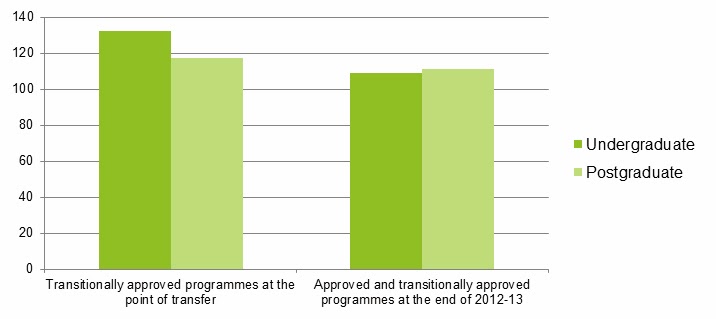
One thing we saw was a twelve per cent reduction in the number of approved and transitionally approved programmes a year after the transfer. Of the 82 education providers running transitionally approved programmes at the point of transfer, 79 continued to deliver social work programmes, with three closing their social work provision entirely. The graph below shows how these closures have affected the split between approved undergraduate and postgraduate programmes over the last year. You can read more about these changes in the full paper, which you can view on our website here.

Comparison of programme numbers at the point of transfer and at the end of the 2012–13 – by qualification level

We also noted that there were significant changes to some programmes in areas such as curriculum design and delivery, and practice placements standards as they adapted to meet our standards, but also due to the recommendations of the Social Work Task Force, including The College of Social Work’s (TCSW) Professional Capabilities Framework.

Our review shows that the approval process was implemented effectively and that we have learned from the recent onboarding of other professions, such as hearing aid dispensers and practitioner psychologists. Specifically, as part of the preparation for the onboarding of the profession, we ensured that we worked closely with TCSW, holding regular meetings and developing a suggested agenda for joint approval / endorsement events.

In the full paper, we have provided detailed analysis about which standards had a higher number of conditions set, and have discussed reasoning for why we needed to set more conditions for these standards. Education providers, in particular those who have yet to have their visit, may find the full report useful in preparing for their own visits.

In particular, we have noted that many conditions were set in several of our broad SET areas, specifically those related to curriculum and assessment (SET 4 and 6), practice placements (SET 5), and programme management (SET 3). However, it is important to note that these are not issues that are specific to social worker programmes in meeting our standards. We expect to see conditions in these areas when onboarding any new profession or visiting new programmes from existing professions.

Number of conditions for social work programmes in 2012–13 – by broad areas of the standards of education and training


Where necessary, programmes have implemented changes to ensure our regulatory requirements are met. This shows that our standards, which are designed to be broad and flexible, can be applied across different professions and education programmes.

All social work programmes that we visited in the 2012-13 academic year have now successfully completed the approval process. The programmes now have ongoing approval confirmed, subject to satisfactory monitoring. We will continue to review the outcomes from our approval visits to social work programmes on a regular basis throughout the next two academic years.

Jamie Hunt
Education Manager
HCPC


Notes:

View the full review paper at www.hcpc-uk.org/assets/documents/100042FESWapprovalreview12-13.pdf

Find out more about our education processes at www.hcpc-uk.org/education/

28 May 2013

Education annual report 2012


Our Education Department approves and monitors education and training programmes throughout the UK. This relates predominantly to pre-registration programmes for the 16 professions we regulate, although we do also approve a small number of programmes linked to post-registration areas of practice. Our standards of education and training (SETs) ensure that a programme that maintains its approval with us produces individuals who are fit to practice and are therefore eligible to apply to our Register.

We published the Education annual report 2012 on Tuesday 7 May 2013. Here, we look at some of the key themes from our review of our approval and monitoring activities across the UK during the 2011-12 academic year.

In numbers
During this period we:
  • conducted 67 approval visits assessing 110 programmes;
  • reviewed 256 annual monitoring declarations and 221 annual monitoring audit submissions;
  • considered 316 major change notifications;
  • investigated four concerns raised about approved programmes that were within our remit; and 
  • transferred 269 social work pre-registration programmes and 27 approved mental health professional (AMHP) programmes to our register of approved education and training programmes following the transfer of social workers in England from the General Social Care Council on 1 August 2012.
The video below provides a brief overview of key facts and figures from this year's report:


Conditions for new programmes
A key area of growth over the last three years related to new programmes for practitioner psychologists and hearing aid dispensers following the opening of these Registers in July 2009 and April 2010 respectively. We concluded the schedule of approval visits to these programmes in summer 2012.

A common theme across these programmes was the number of conditions we applied on approval that related to practice placements. Our SETs require an education provider to hold overall responsibility for placement provision. Conditions in this area are therefore often focused on the quality assurance arrangements the education provider has in place to manage these important areas of teaching and learning.

This is a trend we often see with new profession programmes that transfer over to us and with new programmes from our existing professions. Our Visitors normally ask for further evidence that education providers are well placed to manage practice placements and that placement educators are equipped to provide appropriate learning experiences. This often means education providers must demonstrate that there are formal, documented arrangements underpinning the relationships they have with their placement providers. When considered in this context, these results do not suggest any profession-specific risk profile for either new profession.

To help address this across all professions, we have been delivering seminars for the past two academic years that are focused on supporting education providers in their management of placements. For these seminars, we invited both education providers and placement educators to attend as we recognise the important role they each play in ensuring the education experience meets our standards. These seminars were well attended by representatives from the majority of our professions and facilitated useful discussions about different approaches to the management of placement provision.

The MSC initiative
The Modernising Scientific Careers (MSC) initiative – a workforce strategy from the Department of Health – has also had an impact on education programme numbers, with the creation of 16 new biomedical scientist programmes in 2011-12, which we approved. We also approved a new route to registration for clinical scientists modeled against the new MSC scientific training pathway. It is possible that we may see the creation of more new biomedical scientist and clinical scientist programmes in future years as a result of the MSC initiative.

These developments suggest that our standards remain fit for purpose and can be appropriately applied to a range of professions and models of education and training for the professions we regulate.

Monitoring
When compared over the last five years, it is clear that our monitoring workload is growing. For annual monitoring, we have seen an increase of 85 per cent between 2007-08 and 2011-12. Major change notifications also increased by 32 per cent in the 2010-11 academic year. These increases are expected each year, because as we approve more programmes, more programmes are subject to meeting our monitoring processes. We anticipate further growth as practitioner psychologist and hearing aid dispenser programmes move into our monitoring cycle.

We required additional documentation for 41 per cent of annual monitoring audit submissions. This is comparable with the results from last year, which reflects the requirement for education providers to show how they meet the revised SETs implemented in September 2009. All programmes in the annual monitoring cycle have now provided this evidence and we expect the number of requests for additional documentation to fall again next year accordingly.

No programmes required a further approval visit as a result of an audit submission and only 2 programmes required a further approval visit as a result of a major change submission.  We only decide to conduct an onsite approval visit when the changes submitted by an education provider have significantly changed the way their programme meets our standards. Pleasingly, these results mean our model of open-ended approval is achieving the task it was set out to do: preventing the need for cyclical re-approval visits where possible.

Looking ahead
We anticipate the majority of our approval and monitoring work over the next three academic years to be focused on the schedule of visits to social work and approved mental health professional (AMHPs) programmes in England.

As with all new professions, we will undertake a review of these visits each year to inform our own approval and monitoring approach for these professions and the application of our standards. This review will also feed into future seminar topics and stakeholder liaison that we conduct with the social work profession.

Brendon Edmonds
Acting Director of Education, HCPC

Notes:

You can download a copy of the full Education annual report 2012 here: www.hcpc-uk.org/publications/reports

Further information on the HCPC’s approval and monitoring activities can be found here: www.hpc-uk.org/education

All programmes approved by the Education and Training Committee for meeting our SETs appear on our register of approved programmes: www.hcpc-uk.org/education/programmes/register

12 March 2012

Have you had the conversation yet?


In November 2011, we published a research report exploring what professionalism meant to students and educators in three different professions. Whilst, perhaps unsurprisingly, the research found that there was no one definition of professionalism, participants generally saw professional behaviour as a ‘situational judgement’ – knowing what to do, and what not to do, in a given situation – and it was defined in contrast to behaviour which was considered ‘unprofessional’. The skill of ‘knowing what to do’ included the importance of identifying poor practice and taking appropriate action.

The professionalism of health and care staff certainly seems to be in question in recent, unfortunately repeated, reports about failures in standards of care in hospitals and care homes. These examples will not be repeated here, but, quite rightly, they have led commentators to question not only the role of the regulators involved in monitoring standards, but the responsibility of individual professionals and other staff in speaking-up about poor practice. Last week, the Commission on Dignity in Care for Older People published a draft report for public consultation suggesting ways to ensure that older people are treated with compassion and dignity and receive the services they need. The Commission proposes a number of recommendations to improve the care provided to older people, and of central importance is the concept of responsibility, not just at board and managerial level, but throughout hospitals and care homes. All staff have ‘personal responsibility’ for patient care and ‘should be required to challenge practices they believe are not in the best interests of the people in their care’. These are certainly requirements that are familiar to HPC registrants. They are included in the HPC’s standards of conduct, performance and ethics and we have also published additional information on our website about raising and escalating concerns.

However, I strongly believe it is important in this debate not to focus too much on the negative - the minority who appear before our fitness to practise panels and whose unprofessional behaviour damages public trust. We should not be complacent about poor conduct or poor practice but this means that we need to focus on the majority and our shared responsibility to identify and challenge unprofessional behaviour when it occurs. As one recent report clearly argues, this is important territory. The recently published report (enclosure 08) of a working group established by the Chief Nursing Officer in Scotland to look at professionalism across the nursing, midwifery and allied health professions emphasises the need for professionalism to be clearly articulated throughout the NHS in Scotland in a way which can support all staff to display the behaviours, attitudes and values at the heart of what it is to be a professional. Professionalism is intimately linked with the trust service users place in practitioners and, crucially, with high quality services.

What all these reports indicate is the need for professionals to engage in debates about professionalism. In her February bulletin, Karen Middleton, Chief Health Professions Officer at the Department of Health in England, has recently invited allied health professionals (‘AHPs’) to engage in a ‘big conversation’ about professionalism, but her call to action is surely relevant to all the professions on the HPC Register, in all the various contexts in which they work. The aim is to create an ‘environment where unprofessional behaviour is challenged immediately and constructively on an individual basis’ and we are encouraged to start talking to each other about professionalism and professional behaviour, ‘whenever and wherever’.

So, what do you think is professional or unprofessional behaviour? When is the last time your team had a conversation about professionalism? If you witnessed behaviour that you thought was unprofessional, what would you do?

Have YOU had the conversation yet?


Anna van der Gaag
Chair of the Health Professions Council