Showing posts with label HCPC. Show all posts

26 January 2016

SCPE and me

HCPC registrant, Council Chair and educator, Elaine Buckley, explains the process involved in revising our Standards of Conduct, Performance and Ethics, and highlights their importance to health and care professionals.

On 26 January 2016, we published our revised Standards of conduct, performance and ethics. These Standards have always served to set out what is expected of me as an HCPC registrant. They have provided guidance as I’ve progressed in my career as a physiotherapist, and have assisted me as an educator in articulating these expectations to students as they embark on qualifying in their chosen profession. The Standards are equally as important to the HCPC as a regulator. They help us to determine suitability of character for individuals who apply to our Register, and in cases where concerns are raised about a registrant’s fitness to practise.

As Chair of the working group - called a Professional Liaison Group (PLG) - which assisted with the revision of the Standards, I have been impressed with the thoroughness of the process: particularly in terms of the gathering of evidence to inform any changes and the level of stakeholder engagement. The PLG comprised a variety of stakeholders, including service users and carers, professional bodies, employers and registrants.

The journey to revise the Standards began with a number of commissioned projects capturing the views of a wide range of stakeholders. This included workshops with different groups of service users and carers; focus groups and interviews with registrants and employers; and discussion with Fitness to Practise (FtP) Panel Chairs.

The PLG then reviewed the evidence gathered, debated issues and suggested changes to the previous Standards. This resulted in the development of a robust set of draft Standards, which went out for public consultation UK-wide. The consultation elicited 217 responses from stakeholders including individual health and care professionals, professional bodies, employers and educators. In addition, we benefited enormously from the views of service users and carers at a series of UK-wide events we held during the consultation period. Further changes were made to the Standards in light of the consultation.

The key changes from the previous version of the Standards include a standard about reporting and escalating concerns about the safety and wellbeing of service users. There is also a standard about being open and honest when things go wrong: individuals are expected to tell service users and carers when they become aware that something has gone wrong with the care, treatment or other services that they provide and to take action to put matters right wherever possible. They are also required to consider making an apology and to make sure that the service user receives an explanation of what happened.

It was essential that we refreshed the Standards in such a way that ensured they remained relevant for all 16 professional groups that we regulate. Our registrants work across a range of settings: in the private sector, NHS and in local authorities, to name but a few. This meant that the PLG’s discussions focused as much on format, as on content.

As such, we have made changes to the structure of the Standards to improve their accessibility. We hope that the new concise layout will ensure ease of understanding, not only for our registrants, but also for service users and carers. Despite the new ‘look’ of the Standards, registrants should be assured that the content remains consistent.   

I hope that you will find our revised Standards clear and easy to engage with, and that they will continue to guide your practise as you progress through your career.

The Standards of conduct, performance and ethics are now available to download here. The HCPC will be producing a range of communications to highlight what the revised Standards mean for registrants, including regular articles within our In Focus newsletter, blog pieces, live forums and social media messaging.

For more information visit www.hcpc-uk.org/aboutregistration/standards/standardsofconductperformanceandethics

02 October 2015

Health, disability and becoming a health and care professional

Our new guidance aims to encourage, enable and support disabled people who are considering or training to become HCPC-registered professionals. Policy Officer, Laura Coveney, tells us more.

We think that having a health condition or disability shouldn’t be seen as a barrier to becoming a health and care professional. Indeed, many people who have disabilities successfully complete our approved training programmes, go on to register with us and practise as health and care professionals.

We want to help people with disabilities overcome any perceived barriers to training and then becoming registered with us in their chosen profession. This was the primary reason for producing our updated guidance publication: Health, disability and becoming a health and care professional. It offers insight and advice for those with disabilities, as well as information for education providers about delivering support.

One of the key things the guide does is to break down the process of becoming a health and care professional; from choosing and applying for a course to registering with the HCPC and gaining employment. A brief summary is outlined below.

This four-step process is complemented by a series of case studies from students and staff who have shared their experiences of having a disability and training to become a health and care professional.

Step 1: choosing a course

Those with disabilities may find it helpful to speak to education providers, career advisors, etc., to find out about the support available during training and working in their chosen profession.

Step 2: applying and completing an approved programme

For students with disabilities, it’s important to have a realistic understanding of whether tasks can be carried out safely and effectively. The ability to do certain tasks, or the support needed to carry them out, may change over time. Education providers can assess applications and consider their responsibilities, including making reasonable adjustments if necessary.

Step 3: applying for registration

Part of the HCPC application requires prospective registrants to make a health declaration. We recognise that a disability may not be seen as a health condition.  And we do not need information about any health condition or disability unless it affects your fitness to practise.

Step 4: gaining employment

All professionals using one of our protected titles must be registered before they can begin practising. Similar to education providers, employers are also required to make reasonable adjustments in the workplace to ensure disabled employees are not seriously disadvantaged when doing their jobs.

Health, disability and becoming a health and care professional is available to download here. It is also available in a number of formats on request, including braille and large print.

For more information visit the dedicated health and disability section of the HCPC website: www.hcpc-uk.org/aboutregistration/healthanddisability

29 September 2015

A reflection on my first 100 days with The Health and Care Professions Council (HCPC)

The HCPC's new Council Chair, Elaine Buckley, reflects on her first 100 days in office.

Following the 100th meeting of HCPC’s Council in my first 100 days it’s a good time to reflect on my experience of joining the organisation as Chair. I would therefore like to share with you some of the key elements of my reflections as I approach this key milestone.

In common with many colleagues, I have worked in both health and social care provider organisations and higher education institutions, one thing both sectors have in common is the unrelenting pace of change. I therefore took up the role of Chair of the HCPC wondering if it is possible for regulation to enable change rather than act as a barrier. The evidence I have gathered over my time at the HCPC is moving me towards a conclusion that it (regulation) can, and in fact should, enable change.

The rationale for my conclusion is multifaceted; as a regulator of 16 professions working across a range of sectors, the HCPC has an outcome model of regulation, using a framework of standards relevant to all. This enables registrants to apply them to their own context. Recent work carried out to evaluate our CPD standards provides robust evidence to support this theory. Our programme of education visits also demonstrates that innovative programme design and delivery is possible within the framework of our standards of education and training.

Partnership is another key feature of how we work at the HCPC, whether that be with professional bodies, registrants, service users, employers or education providers. For example, we have recently worked with and launched a campaign to highlight the benefits of using arts therapists to employers. The organisation also has a broad programme of events and consultations, aimed at either gathering opinion or sharing evidence and good practice. We recently consulted on the revised standards of conduct, performance and ethics and guidance for disabled people wanting to become health and care professionals both which will be launched in the coming months. I am also very much looking forward to my first series of public events in Scotland next month. We are committed to being 'in touch' with the professions that we regulate and these events provide a vital opportunity to share and also hear what is happening.

Continuous quality improvement dominates the culture of the HCPC. That could be in response to stakeholder feedback through our regular research activities. It could also be through a cyclical programme of standards review, to ensure they remain relevant and current or our on-going work to further engage with members of the public, service users and patient safety groups. 

I have been fortunate to join a very effective and efficient organisation, but it’s by no means complacent. There is much work we need to do in order to ensure that the model of regulation we adopt delivers its ultimate objective; public protection, but in doing so enables our stakeholders to respond to the changing demands within their operating environment, whenever and wherever that might be.

Activity for the coming months includes refreshing the strategy for 2016 and beyond, publication of the new standards of conduct, performance and ethics and beginning work on reviewing the standards of education and training as well as improvements to our fitness to practise processes and our registration systems.

I look forward to working with my colleagues over the coming months and years to continue to strengthen the evidence base for regulation and build even stronger engagement among our stakeholders. 

14 August 2015

What happens if a concern is raised about me?


8 things you should know if a concern is raised about your fitness to practise.

1. The fitness to practise (FtP) process is not designed to punish registrants for past mistakes.

Rather, the process is designed to protect the public from those who are not fit to practise. Finding that a registrant’s fitness to practise is ‘impaired’ means that there are concerns about their ability to practise safely and effectively. In 2013-14, 1.2 per cent of social workers in England were subject to an FtP concern; a very small percentage, indicating that the vast majority of registrants are practising safely and effectively.
 
2. Your case will be allocated to a case manager.

If you find yourself the subject of a fitness to practise allegation, the case will be allocated to a case manager, who will remain neutral. They can explain how the FtP process works and what panels will consider when making their decisions. However they cannot advise you what to include in your response or how you should represent yourself.

3. We will give you an idea of how long our enquiries will take.

We understand that it can be stressful when an FtP concern is raised, and we will provide you with an idea of how long our enquiries will take at each stage of the process. In 2013-14 the length of time of cases referred for a hearing to conclude was an average of 17 and a median of 14 months from receipt of the allegation.

4. You can respond to the allegation in writing within 28 days. It is important to engage with the process so that you can give your side of events.

Once we have all the information we need, we will write to you with full details of the allegation that has been made plus copies of the documents we have collated. You are then invited to respond in writing within 28 days. If you need more time, your case manager can offer a 28-day extension, and if further time is required you can make a written application to the panel. 

5. You may find it helpful to get advice from your union, professional body or a solicitor at the earliest opportunity.

They will be able to provide advice on what to include in the response to the allegations which will be provided to the Investigating Committee Panel.

6. You are entitled to be represented throughout the process.

If the case is referred to a hearing, registrants are entitled to be represented, or can represent themselves, throughout the process. Information and guidance on the fitness to practise hearing process is available on our website, and explained in this useful YouTube video.

7. Cases are scheduled up to four months before the actual hearing.

We try to give registrants at least 60 days’ notice of the hearing date. We will also give you the material that we plan to rely on at the hearing 42 days beforehand. We ask registrants to provide their material 28 days before the hearing date.

8. Details of the hearing and allegations are published four weeks before the hearing is due to start.

We put this information on our website as the hearings are held in public. We do not put the information on the website more than four weeks before the hearing date to make sure we are acting fairly and balancing your rights with our role of protecting the public.

For more information download our brochure information ‘What happens if a concern is raised about me?’ or visit www.hcpc-uk.org/complaints/registrants


22 July 2015

Applying for HCPC registration?

Registration Manager Dushyan Ashton highlights what you need to do to avoid having your application returned as incomplete.

Proud excited faces, mortar boards scattered against a sky-blue background, and groups of students posing in smart black gowns. The numerous photos posted on social media by newly qualified students - now graduating after successfully completing one of our approved programmes - are a happy reminder that graduation season is in full swing.

All those students completing an approved education and training programme are required to join our Register before they can practise using one of our legally protected titles.

During this current period our Registration Department will receive lots of new applications. We aim to process applications within ten working days of receipt of a complete application. This ensures that newly qualified professionals are added to our online Register as soon as possible.

It is important to make sure that your application is complete before submitting it to us. Common mistakes include failing to provide the appropriate documentation, or not including a fee with the application form. Incomplete applications will be returned for resubmission, which could potentially delay your entry to the HCPC Register.

To avoid this happening follow our checklist:
  • Enclose two certified copies of documents to confirm your identity; one document should contain your photograph, one should provide your current address.
  • All signatures must be original and dated within the last six months.
  • Provide certified proof of any name changes; e.g. a certified photocopy of a relevant name change document such as a marriage certificate or deed poll.
  • A fee must be submitted with your application form.  
  • If you answered ‘yes’ to any question in section 3 (character and health self- declarations / vetting and barring schemes), you must provide additional information.

For further information about applying to join the HCPC Register
visit www.hcpc-uk.org/apply

14 July 2015

Fitness to practise: advice for employers and managers


HCPC's Head of Fitness to Practise Service Improvement, Sarita Wilson, highlights 10 things you should know if you have concerns about an employee’s fitness to practise.

1. If a registrant is ‘fit to practise’ this means that they have the skills, knowledge and character to practise their profession safely and effectively.

Fitness to practise (FtP) isn’t just about professional performance; it also includes acts by a registrant which may affect public protection or confidence in the profession. For example, if a registrant has been cautioned or convicted for a criminal offence.

2. The Health and Care Professions Council (HCPC) will consider cases which question whether a registrant’s fitness to practise is ‘impaired’, or negatively affected.

This could be by misconduct, a lack of competence, a caution or conviction, the registrant’s physical or mental health, or a decision made by another regulator responsible for health and social care.

3. Incidents involving employment issues which don’t affect the safety or wellbeing of service users do not need to be referred to HCPC.

For example: lateness or poor time-keeping (unless it has a direct effect on service users); personality conflicts (as long as there is no evidence of bullying or harassment); sickness or other absence from work.

4. Concerns should be reported to the HCPC if…

…the behaviour or actions of a registrant have raised concerns about their fitness to practise; you have dismissed or suspended a registrant; you have taken the decision to downgrade the status of a registrant (for example, you place them under supervision).

5. Fitness to practise and employment processes are different and can result in different outcomes.

Issues that cause you as an employer or manager to take disciplinary action may not result in the HCPC placing any sanction on the registrant. In other cases, HCPC may take more serious action than you, which means that the registrant may not be able to work in their profession or has restrictions placed on their practice.

6. Letting HCPC know about your concerns does not necessarily mean that fitness to practise proceedings will begin immediately.

Neither does it mean you would have to suspend or end your own procedures. In many instances it will be more appropriate for HCPC to wait until you have finished your procedures. Even if HCPC does not immediately pursue an allegation, they are better placed to protect the public.

7. To raise a concern you should fill in an employer referral form.

This can be downloaded at www.hcpc-uk.org/complaints/
employers/raiseaconcern and emailed or posted to HCPC. Anything sent to HCPC will be copied to the registrant you are referring so that they can respond. If there is anything you would prefer not to be sent to the registrant, you should notify HCPC.

8. If you raise a concern with HCPC you can expect everyone involved to be treated fairly and be given an explanation as to what will happen at each stage.

You will also be given details of a case manager who you can contact should you have any questions.

9. You may be required to provide a witness statement or give evidence.

If the case is referred to a final hearing, you or members of your staff may need to meet with the HCPC’s solicitor to provide a witness statement. You may also be required to come to the hearing and give evidence. HCPC will organise your travel and accommodation if this is the case.

10. Employing a registrant who is the subject of a current FtP investigation.

Being the subject of an FtP investigation does not automatically make a registrant unsuitable for employment as they can continue to practise unless the HCPC has imposed an interim order preventing them from practising or placing restrictions on their practice. You can find out if a registrant has an interim order made against them by searching the HCPC Register.

For further information and advice for employers and managers visit
www.hcpc-uk.org/complaints/employers

16 March 2015

AMHP training and education programmes: how can the conditions set during 2013/14 approval visits inform and guide education providers?

This was one of the key questions considered by our education team following the first year review of approval visits to AMHP programmes. Education Manager, Ben Potter, explains.

As part of the transfer of the General Social Care Council’s (GSCC) regulatory functions to the HCPC in August 2012, we became responsible for approving and monitoring AMHP education and training programmes in England.

All approved AMHP programmes are required to meet our criteria and conditions can be placed on programmes that do not. These conditions must be met before we can approve or continue to approve a programme.

During the 2013-14 academic year we considered 17 programmes at 11 education providers. We are scheduled to visit a further ten transitionally approved programmes at eight providers in 2014-15.

All AMHP education and training programmes visited in 2013/14 have now demonstrated how they have met any conditions placed on them – thus demonstrating how they meet our criteria – and are now approved.

To help, inform and guide education providers for the future, here we consider the two areas that incurred the highest number of conditions so that we can provide further understanding of certain aspects of our approval criteria. Our full report – Review of the Health and Care Professions Council (HCPC) approval visits to approved mental health professional (AMHP) education and training programmes in the 2013-14 academic year – is available to download.

Practice placements

As an education provider, you need to own and manage practice placements, including policies and procedures around approval and monitoring of placement settings; the staff in place; and ensuring that placement settings provide a safe and supportive environment.

When setting conditions in these areas, we often found that education providers would not own the policies, or would make assumptions that the placements were well-resourced in terms of staff, due to them being in statutory settings.

There were also assumptions by education providers that placements were providing a safe and supportive environment for students, due to the post registration nature of these programmes meaning that students were often employees of the organisation that provided their placements.

When we applied conditions in this area, education providers had often not considered that these employees / students need to be supported differently when undertaking activities to support their AMHP training in their place of work, when compared to how they need to be supported when carrying out their day to day role.

Documentation

Documentation underpins how programmes run in every area. We require documentation to communicate expectations about how a programme will interact with its stakeholders – including students, placement providers, and staff – and that it clearly defines the roles and responsibilities of all parties in the running of the programme.

As an education provider, if your documentation is of a poor standard, we are unable to make a well-informed judgement about whether particular criterion are met. When we are unable to fully assess and reach a decision, we need to apply a condition to ensure that the criterion is met.

How can understanding these key issues help to inform a future approval visit?

As an organisation, we have learnt a great deal from these visits and about how we will aim to help, inform and guide education providers participating in future visits.

You can find a range of guidance about our approval visits on the HCPC website. There are also online resources, featuring case studies and presentations from our seminars delivered to education providers in autumn 2014.

If your AMHP programme is being approved in 2015, or if you would like advice about the AMHP approval criteria, you can contact the member of our team allocated to manage your approval visit, or you can email education@hcpc-uk.org.


09 March 2015

Top 10 tips for completing your CPD profile

Have you been selected for CPD audit? Here’s ten top tips for completing your profile.

1. Include a dated list of your professional development activities within the audit period - the last two years of registration. If you have any gaps of three months or more, they will need to be explained.

2. Don’t just describe your day-to-day work. Choose a range of different activities you have undertaken over the past two years (between four and six in total) and describe what you learned from each.

3. Provide good evidence for each of the activities. Reflective logs, case studies, presentations, certificates and feedback from your service users would all be relevant.

4. Remember, it is about quality not quantity - choose evidence which shows how you think you have met the standards.

5. Ensure confidentiality when including your evidence - make sure that none of your evidence or your statement includes references to named individuals.

6. Make sure that the evidence you send will back up the statements made in your profile. It should show that you have undertaken the activities you have referred to, and should also show how they have improved the quality of your work and benefited service users.

7. Be concise, but provide sufficient detail on how your learning activities had an impact on your service, and be clear about how each standard has been met.

8. Keep a personal log of your continuing professional development, so that if you move jobs or your circumstances change you will still have access to it.

9. Don’t forget that the summary of your practice history should help to show the assessors how your development activities are linked to your work.

10. The council’s approach to assessing professional development focuses on the outcome of your activities - how they have benefited you and your service users, not how many hours or points you have. It’s up to you, along with your manager, to think about what you need to do to keep up to date in your area of practice.

For more information and advice for completing your CPD profile, visit
www.hcpc-uk.org/registrants/cpd.


23 February 2015

The 5 W’s of the amended approvals process for supplementary and independent prescribing programmes

Head of Educational Development, Brendon Edmonds, summarises the HCPC’s recent review of the amended approval process for supplementary and independent prescribing (SPIP) post-registration programmes.

An introduction to independent prescribing

Independent prescribing is prescribing by an appropriately qualified practitioner responsible for the assessment of patients with undiagnosed or diagnosed conditions, and for decisions about the clinical management. Independent prescribers can prescribe any medicine for any medical condition within their competence.

In 2009, the Department of Health (DH) published a report looking at the use of medicines by the allied health professions (AHPs). The report looked at whether prescribing and medicine supply mechanisms for AHPs should change to address patient and service needs. It found a strong case for extending independent prescribing to chiropodists/podiatrists and physiotherapists. In July 2012, the DH announced that legislation would be passed to allow appropriately trained chiropodists/podiatrists and physiotherapists to act, and be annotated on our Register, as independent prescribers.

As a result of this new legislation, the HCPC developed and published standalone standards for prescribing. We also amended the approval process for supplementary and independent prescribing (SPIP) post-registration programmes, which was reviewed in the 2013-14 academic year.

Here, we summarise the review and its key findings. The full report is available to download here.

WHEN…
 
When did the HCPC’s standards for prescribing come into effect following the revised legislation?

As part of the legislative change, we produced standards for prescribing. These came into effect from August 2013, following the legislation passing.

To develop these standards, we engaged with stakeholders and undertook a public consultation. The standards cover two areas: standards for education providers and standards of SPIP prescribers. The standards for education providers are based on our standards of education and training, whilst those for all prescribers are proficiency based, and expand upon the standards of proficiency required of chiropodists/podiatrists, physiotherapists and radiographers who undertake supplementary prescribing.

WHY...
 
Why does the HCPC have an amended approval process for SPIP post-registration education and training programmes?

The development of this amended approval process was a direct response to the DH changes to prescribing legislation in 2012.

It was already commonplace for education providers to deliver independent prescribing (IP) programmes for professions that we don’t regulate (pharmacists and nurses) and supplementary prescribing (SP) for ones that we do (physiotherapists, radiographers and chiropodists/podiatrists).

However, we needed to be sure that independent prescribing could be supported for our professions and in relation to our prescribing standards.  As we already approve SP programmes, we were satisfied that new independent prescribing programmes would already meet some of the standards for prescribing. We were also satisfied we didn’t need to conduct a full approval visit to assess them - hence the need for an amended approval process.

This gave eligible education providers the opportunity to gain approval for prescribing programmes in a significantly shorter timeframe than our standard approval process. In fact on average, programmes were approved ten weeks after their documentary submission – less than half the average time taken for programmes via the full process (22 weeks).

This really demonstrates how we’re able to amend our processes to support the work and initiatives of health and care providers.

WHO…
 
Who did the legislative changes affect and how did this impact education providers?

The changes to prescribing legislation meant that our chiropodist/podiatrist and physiotherapist registrants could act as independent prescribers once appropriately trained and annotated on our Register.

Prior to, and soon after, the legislation being passed, we wrote to education providers which delivered approved supplementary prescribing (SP) programmes to let them know how the amended approval process would work. We also advised them we would assess their programmes against the newly published standards for prescribing.  

Our process reduced the burden of work required for education providers to evidence how they met the required standards when compared to the full approval process. This was because they were only required to focus on the standards which were directly impacted by the introduction of independent prescribing. 

WHERE…  
 
Where did the HCPC find its visitors for the approvals and monitoring work?

We work with visitors who make the assessments of programmes to ensure they meet our standards. For prescribing, we set rules about selecting visitors for this specific area of approvals and monitoring work.

Our visitors work together in pairs to make an assessment.  At least one of the visitors had to be from a non-medical prescribing profession which was entitled to undertake independent prescribing training (a nurse or pharmacist). This visitor was required to be registered, with the entitlement recorded on their respective register.

We also recruited independent prescribing visitors to competencies that were based on the competencies for the visitors of our 16 professions.

WHAT…

What were the key outcomes of the amended approval process?

We reviewed 100 prescribing programmes at the assessment days in November 2013.

Visitors were able to request further documentation if they were not satisfied that a standard was met following their review of the documentation. Visitors could also recommend a full approval visit if there were issues remaining following their assessment of a programme. 62 per cent of the programmes assessed met the standards for education providers without the need for additional documentation, as demonstrated in the graph below. This outcome contrasts with the full approval process, where only three per cent of programmes visited in 2012/13 were approved following our first assessment.

So why was this?


There are a number of reasons:
  • Education providers were not fundamentally altering their existing prescribing provision to incorporate independent prescribing.
  • All of the education providers that engaged with this process ran existing HCPC approved SP programmes, and many ran IP programmes for nurses and pharmacists.  
  • The education providers were already familiar with our standards and processes.
Programmes required to submit further documentation were able to evidence how they met our standards, and all 100 prescribing programmes were approved by February 2014. None of the programmes required a follow up approval visit. Therefore, we have granted open-ended approval to these programmes and it will remain in place, subject to meeting our ongoing monitoring requirements.

The outcome of approving these programmes is that individuals from the relevant professions can have their registration record annotated as an independent prescriber, once they complete the relevant training. To date, we have updated the records of 150 registrants with the independent prescribing annotation. 

17 February 2015

Preventing small problems from becoming big problems in health and care

I recently attended the 26th conference of the US Institute of Health Improvement, and had the privilege of hearing Don Berwick and Atul Gawande amongst many others sharing their reflections on the changing landscape of health and care. I was struck by the strong focus on looking for new ways to reduce staff burnout and to invest more in the human aspects of care. Having strong and resilient relationships at work was seen as key to providing sustainable care. Kindness and compassion were just as important to good care as technical skills and knowledge. Addressing these aspects of care, both for service users, patients and for professionals, was given great emphasis. Gerald Hickson spoke about the "power of an honest conversation" as an important part of this process.

Our work on professionalism reflects this pursuit of greater awareness and understanding of the interpersonal aspects of care. I am very pleased that our latest research in this area continues this exploration, and reflects the mood and direction of thinking in a wider arena. Preventing small problems becoming big problems in health and care explores the reasons behind incremental disengagement, where challenging circumstances appear to lead to concerns about practise, and eventually to a complaint. Patients and service users in the study recognised the pressures and challenges of delivering high quality care, and the need to ensure professionals were supported to do their jobs well.  They said they wanted to be seen by professionals who were compassionate, communicative, and consistent in the care they provided.

Feedback from professionals in the study highlight the links between poor supervisory structures, lack of peer support, professional isolation and disengagement from practise. Disengagement was characterised as a symptom of underlying, often longstanding issues in the workplace which could be addressed and might be resolved before complaints arose. Not rocket science to anyone working in health and care services, but nevertheless important to the debate about what needs to change.

I was struck by words from Atul Gawande who spoke about ways in which services and professionals must evolve in response to the changing needs and expectations of society. A strong advocate for team based care, and the need to break down hierarchies amongst professionals.

Gawande suggested that "The relationship between clinicians and institutions has been like a tenant and landlord relationship. Clinicians expected to be left alone by their landlords to do what they did. But now, it has changed. Thinking about what happens in hospitals and clinics, and allowing others in, has become crucial."

This notion of "allowing others in" is enormously complex. At one end of the spectrum, this means allowing reflection and self awareness to generate those honest conversations with trusted colleagues at an early stage, as a means of addressing problems early on. At the other end of the spectrum, it can mean investigation by a regulator. Between the two ends lie conversations and interventions by managers, educators, and professional associations. My hope is that our work with Zubin Austin, Carole Chistensen-Moore and Joan Walsh will help to generate more activities at the reflective end of the spectrum, and reduce the activities at the regulatory end. It is in everyone's interest to prevent harm, to reduce complaints, and to see more emphasis on support, kindness and compassion in health and care.

Anna van der Gaag

10 February 2015

Time for a new Chair at HCPC

 Public appointments, quite rightly, require those who hold office to stand down after two terms. This is to safeguard against office holders becoming too stale, or too close to the organisation they are charged with governing. Although I feel great personal sadness that I stand down from my role as Chair in June 2015, I believe wholeheartedly that this principle is the right one.

The role of the Chair is to provide clear strategic leadership, working closely with the Council and the Executive to keep the objective of the organisation - that of public protection - at the heart of all decision making. On a day to day basis, financial and operational oversight are also key aspects of the work, but it is maintaining this clarity of purpose around what regulation is for, that is most central to the job. This manifests itself in many different ways, working closely with the Council and the Executive team and engaging with the very many stakeholders who have an interest in the work of the regulator.

The HCPC is unique amongst regulators. Set up in 2002, the organisation has established itself as a multi professional regulator with a worldwide reputation. In the last eight years, it has doubled in size, taken on four additional professions, and been proactive in its pursuit of delivering transparent and proportionate regulation. Amongst its defining characteristics lies a single governing Council, one set of standards and processes for all 16 professions, and a commitment to treating all professions as equal, regardless of size or perceived status. This sense of equality extends throughout the organisation - the Council members and the Executive team work as equals around the table, valuing diversity of opinion and experience, with a shared committed to continuous change and improvement. Dialogue with our colleagues in health and social care, in the four governments of the UK, in education, professional trade unions and associations, and other regulators is an important part of the day to day work.

Looking back over the years, there are a number of developments that illustrate the culture of the HCPC. I am proud of the way in which the organisation has pioneered an evidence based approach, arguing that if health and care professionals are being asked to be evidence informed, so should the regulator. We have focused our research efforts on many areas, notably on professionalism, and on creating a better understanding of the experience of regulation from different perspectives  - complainants, professionals, students, employers, educators and the perceptions of a wide range of patients, service users and the public. We have been fiercely defensive of using evidence to inform our decision making, even when those decisions were not in line with wider views and opinions of the day.

I am also proud of the way that HCPC has developed its engagement with service users and patients. Conscious of the trap of tokenism, we have worked hard to create authentic and meaningful forms of engagement, to listen and work closely with users in many different settings. Regulation is there for the public, and it must be intelligible, accessible, responsive, and visible for those who need it. We have worked hard over the years to improve our communications, so that individuals know where to find us, and judge us to be trustworthy to act when standards are not being met.

My final observation, for those who might be considering applying for this role is that the HCPC is quite simply a great place to work. It has a strong "can do" culture running through it. The people who work here are highly committed, hard working, and open to change and improvement. The Council work well as a team, clear about their role and of the territory best left to the Executive.

It was John Carver who observed that the role of a Chair is to protect and further the integrity of governance, as a servant of the Board and the organisation. I can think of no better place to pursue this goal, and no better team to work with.


04 February 2015

5 key findings from social work programme approvals

Jamie Hunt, Education Manager at the HCPC, talks through some of the observations and trends following the second year of social work programme approval visits.

The 2013-14 academic year saw the Education team complete the second year of approval visits to social work programmes. In total we visited 113 programmes at 43 education providers, 16 of which were new programmes.

The purpose of the process is to ensure an education provider:
  • has a robust framework to manage all aspects of their programme effectively;
  • holds responsibility for all aspects of their programme, including placement environments;
  • has curriculum and assessment which support the delivery of our standards of proficiency for social workers in England, and;
  • can make good decisions about those individuals who receive the final approved award.
If we find areas which do not meet our standards following an approval visit, we will set conditions which must be met before it can be approved.

With other professions previously new to HCPC regulation, we’ve found that education providers better understand our quality assurance approach over time, and therefore work effectively to align their programmes to our standards. This usually means that as the series of approval visits progresses, the fewer issues we identify. This was certainly true of our approval visits to social work programmes in the 2013-14 academic year, in comparison to the previous year.

Here, we have summarised some of the key observations and trends. Our full report – Review of the Health and Care Professions Council (HCPC) approval visits to social work pre-registration education and training programmes in the 2013-14 academic year – is available to download on our website.

Social work programme approval visits 2013-14: 5 key findings

1. On average, we applied 1.8 fewer conditions per social work programme in the 2013-14 academic year compared to the previous year. 


This result suggests social work education providers are becoming more familiar with our regulatory requirements. They are successfully providing the evidence to meet our standards prior to and at the visit itself.

2. Education providers are more aware of the importance of managing issues regarding student consent.

SET 3.14 requires education providers to ensure that: “where students participate as service users in practical and clinical teaching, appropriate protocols must be used to obtain their consent”.

Last year, we found we applied conditions to 56% of programmes but this has dropped to 33% in year two. This suggests there is greater understanding amongst programme teams regarding getting informed consent from students where they are involved in role play or are sharing personal information. 

3. Many of the conditions we placed on programmes were linked to:
  • Inadequate programme documentation
One way to demonstrate a robust framework is in place to manage a programme is ensuring all areas are clearly documented. This is why we ask education providers to submit copies of key programme documents (e.g. programme and placement handbooks). We commonly set conditions where we find inconsistency, or an absence of information, in these documents which could affect a stakeholder’s engagement with a programme.
  • A lack of documented policies and systems, used to manage a range of programme areas
To approve a programme, policies and systems must be in place, written down and appropriately applied. As a regulator, we do not solely rely on the establishment of good will and long-standing relationships between various stakeholders to support a programme’s delivery. We need to be satisfied an education provider can effectively identify, manage, mitigate and learn from issues and risks and in doing so, maintain the level of quality that our standards require of them.
  • Clarity regarding how the programme meets Standards of Education and Training (SETs) and supports individuals meeting our Standards of Proficiency (SOPs)
Education providers need to clearly identify how their programme aligns to our standards. This can take time and this is one of the reasons we provide education providers with a six month lead in time to the visit itself. Careful thought is needed to consider how the programme meets our SETs and SOPs and it is important that this is mapped clearly for the benefit of our visitors who will assess the programme. This process of mapping should also allow an education provider to identify any potential gaps in how they meet our standards prior to the visit.

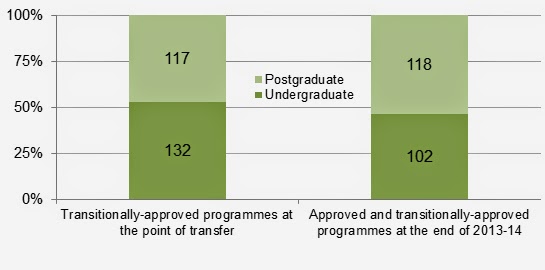
4. A shift in the split between undergraduate and postgraduate programmes sees more social work programmes being delivered at postgraduate level.

At the point of transfer in August 2012, 47% per cent of programmes were delivered at postgraduate level. At the end of the 2013-14 academic year, 54% of programmes were delivered at postgraduate level.


5. All social work programmes visited in the 2013-14 academic year have now successfully completed the approval process.

This means that programmes with conditions placed on them have now evidenced that all conditions have been met. Once a programme has met all our standards through an approval visit it receives what is called 'open-ended' approval. This does not mean these programmes are approved indefinitely. They will need to continue meeting our standards through mandatory engagement year to year with our monitoring processes.

We prefer to keep regular engagement with the programmes we approve, rather than running a re-approval cycle. It allows us to assess incremental changes to programmes largely as and when they occur. Importantly, where significant changes are identified in our monitoring processes, we have mechanisms in place to enable a new approval visit to be initiated if required.

In conclusion

We are pleased to see that the work we have carried out with education providers is proving effective. Over the past two years we have delivered seminars aimed at those providers who were yet to undertake an approval visit, and have supported providers with guidance literature and through our newsletter, Education Update. We were also able to directly address any issues with members of programme teams before their visit. We also widely publicised the findings of our first year review and we’ll be doing the same this year, so have a read and share our findings.

Our second year report is not intended to be a comprehensive review of social worker education in England. We are still part way through our three year programme of visiting transitionally approved social work programmes, and it is too early to draw full conclusions about the impact of the standards of education and training (SETs) in assuring, and driving improvements in, social work education. We intend to begin a more comprehensive review at the end of the 2014-15 academic year.


04 August 2014

A UK wide Council for a UK wide Regulator

Vibrant, successful governance depends upon maintaining a strong team. In August, the Health and Care Professions Council (HCPC) is launching its recruitment campaign to appoint new members to its Council. Four of our existing members are coming to the end of their term of office, and cannot be re-appointed as they have reached the maximum time period allowed for serving on a Board.
This has been another year of achievement for the organisation. We continue to meet the standards set by the Professional Standards Authority, and we were described in its latest report as an effective regulator (1). Our UK wide Register holds 320,000 professionals from 16 professions, and we constantly improve our processes to ensure that we deliver our regulatory functions. There is no room for complacency, and as we grow we remain focused on continuous improvement in our processes. HCPC has always had a strong commitment to extending public protection through statutory regulation, and there is no sign of this diminishing. Next year, we will open a new register for Public Health specialists, and we continue to contribute to the debate about further professions and whether or not statutory regulation should be introduced for them. Over the last few years, we have had a particular focus on the challenges of holding care workers to account. This year, the Health Select Committee Report supported our proposals for the implementation of a new form of regulation for adult care workers (2).

Beyond this, we are undertaking further reviews of our standards and research to bring better understanding of regulation and its purpose. Health and social care is becoming ever more complex, and public expectations of what professionals deliver is changing. We continue to engage with other agencies and with government to raise standards and deal swiftly with instances of poor care.

These are just a few of the challenges that our four new members will be engaging with as they join our Council. We are non executives who want to see better protection for the public, and ever better, more efficient regulation of health and care professions across the UK. This UK wide perspective has always been of great importance to the HCPC, and throughout our history we have maintained a team drawn from all four countries of the UK. Health and social care is in a constant state of change, and there are significant differences between the four countries of the UK. The Council must continue to engage with this diversity and understand the implications for regulation.

Perhaps most critical of all, we are seeking new members with a personal commitment to public service (3). It was Bob Greenleaf who observed many years ago that legitimacy begins with trust. ‘The only sound basis for trust is for people to have the experience of being served by their institutions’  HCPC’s sole purpose is to deliver public protection. It exists to serve the public through setting and maintaining standards for many thousands of health and care professions. A huge, exciting challenge.


References
1. Professional Standards Authority Performance Review 2013-2014. www.professionalstandards.org.uk
2. 2014 Accountabilty hearing with the Health and Care Professions Council. First Report of Session 2014-15. http://www.parliament.uk/
3. Good governance http://hcpc-uk.blogspot.co.uk/2013/08/striving-for-good-governance.html

Anna van der Gaag
Chair
HCPC

Benefits of being a Council member


10 April 2014

An opportunity to stop poor care through new Law Commissions' Draft Bill

Last month I attended a lecture by Robert Francis QC at the Royal Society of Medicine. Predictably, he was reflecting on the lessons from his Inquiry into events at the Mid Staffordshire Hospital Trust. At the end of a powerful lecture, challenging doctors to take action, he was asked for his reaction to the lack of progress on his recommendation to regulate care assistants. He responded by saying that in his view, “too little was being done”, adding that he was waiting with interest to see how the recommendations of the Cavendish review would unfold.

There is broad consensus that Camilla Cavendish provided a very clear direction on the roles and responsibilities of employers and managers, the importance of training and supervision and mentoring for support workers, emphasising the vital role they play in delivering health and social care. However, these mechanisms will not stop the tiny minority of individuals in the care sector who commit serial offences, and who successfully move from one care setting to another without redress. This is the group that HCPC have suggested require legislative change to bring them into a system of personal accountability.

Part 7 of the recently published Law Commissions Health Bill was therefore a welcome development in this long running, complex, and challenging area. The draft legislation from the Law Commissions make provisions for professional regulators to establish barring schemes which would allow investigation and adjudication of unregistered care workers. If a complaint was upheld, the individual would be barred from working in the sector and would be put on a list circulated to employers and available to the public on the internet. This would be a cost effective and proportionate mechanism for dealing swiftly with poor care. 

The evidence from Australia, where this scheme is already in place, is that it is having a positive impact, proving a critical deterrent to those who would circumvent the system of accountability. We know from the data there that this kind of behaviour is not common, but where it does occur it can have a devastating effect on patients, service users and their families. After the shocking events of Winterbourne View, I wrote a piece on this blog which described why regulators as well as employers needed to act to bring about change in the care sector. The subsequent stories of appalling care in Mid Staffordshire, in Lanarkshire, in West Sussex and London, all point to the need for legislative change. I commend this section in the Law Commissions' Bill and look forward to seeing it become law. HCPC, if given powers to take action in the social care sector, will do so with vigour and determination.

Anna van der Gaag
Chair
Health and Care Professions Council


References
The Independent, 9 April 2014
http://www.independent.co.uk/life-style/health-and-families/health-news/nhs-bad-eggs-could-be-struck-off-under-new-regulation-plans-drawn-up-by-the-law-commission-in-response-to-midstaffs-scandal-9231222.html

Flynn M (2012) Winterbourne View Hospital: A Serious Case Review. South Gloucestershire Safeguarding Adults Board
http://hosted.southglos.gov.uk/wv/report.pdf

14 February 2014

HCPC seminar series asks: Who are your service users?

The new standard of education and training

Following research in 2012 and consultation last year, we have decided to amend the standards to require the involvement of service users and carers in all approved programmes. This recognises the important role this involvement plays in ensuring students are fit to practise at the point they complete their programmes and join the Register.

The new standard states: "Service users and carers must be involved in the programme."

Service user and carer involvement seminars

To introduce the new standard support education and training providers, we have held a series of seminars throughout the UK.

At these seminars, delegates were given a brief overview of the new standard and what it means for them as education providers, before undertaking some group activities to determine who they can involve in their programme and how. Education providers were given the unique opportunity to play the HCPC’s ‘Service User and Carer Card Game’.

For this, delegate groups were given a series of cards detailing fictional characters and asked to decide who would be service users or carers for a certain HCPC profession, under the new standard’s guidance. Taryn, a barmaid who participates in research studies, and Charles, a welfare benefits solicitor, were just two of the 26 characters, who each sparked some thought-provoking questions and discussions between delegates, such as:
  • Are the service users and carers necessarily individuals or can they be groups or organisations?
  • Are they all direct users of the services for a profession or can the perspectives of those indirectly affected by the work of health and care professionals be relevant?
  • Are they the end users of a service or might intermediate users of services, such as other professionals, also have valuable contributions?
  • And to what extent can different groups or individuals get involved in an education and training programme?
“The game was a great way to think about who service users and carers might be. I’d like to bring it back to my own team.”
Using scenarios, delegates then built on these themes, comparing possible approaches that education programmes might take and looking at some of the potential barriers and benefits that may arise.
Recruitment, support, representativeness and avoiding tokenism were all topics for consideration, whilst also looking at the appropriateness of involvement activities in the context of the other SETs.

The seminars also featured videos to encourage reflection and discussion around the theme, which triggered some delegates to consider the use of digital media and platforms in embedding service user and carer contributions in education or training programmes.


Service user representatives attended some sessions, enriching the discussions with invaluable insights into the education and training of professionals from their perspective.

The seminars proved an important opportunity for education providers to share their experiences with representatives from other professions and programmes, and talk to us about our expectations for the new standard.

“I found the activities very thought provoking.”
“I have learned a great deal about the HCPC today as well.”

Service user and carer involvement and you

What do you think are some of the approaches you could take to involve service users in your own programme? What are some of the challenges? Do you have experience with a successful way to involve service users? Please share your thoughts and comments below.

Nicola Baker
Education Officer
HCPC

Notes:
  • Download a copy of the new standard and supporting guidance here [PDF]. 
  • We will be rolling out the new standard on a phased basis and will apply as follows.
    • From 2014–15 - new programmes, transitionally approved programmes and programmes requiring a visit as a result of a major change or annual monitoring submission.
    • From 2015–16 - all other approved programmes, including prescribing programmes, formally assessed through annual monitoring
    • Immediately -  Approved Mental Health Professional (AMHP) programmes at approval visits.
  • If you have any questions about the new standard and what it means for education and training providers, please contact us at education@hcpc-uk.org 
  • Education seminars take place each year on relevant topics for education and training providers. You can find out more information here.

11 February 2014

A journey of a thousand small steps: Thinking about competence in a different way

Last week, a year to the day after the Francis Report on Mid Staffordshire was published, we hosted a seminar to continue our discussions on professionalism and to launch the next stage of our research (1). The seminar was led by Professor Zubin Austin from the University of Toronto, who has a particular expertise around competence and how we understand it in a health and care context (2). We were particularly pleased to welcome so many representatives from professional bodies, employers, educators and other regulators to this forum.

Professor Zubin Austin’s work in Ontario illustrates a number of important themes highly relevant to the collective desire to see improvement in health and social care in the aftermath of Mid Staffordshire.

First, that patients and service users are likely to have different expectations of professional competence from professionals. Service users and patients want professionals to be ‘accessible’, and ‘affable’. Technical know-how is important, but not more important than clear communication and authentic respect.

Second, the evidence suggests that professionals who are competent have several characteristics in common: they are professionally networked, and express satisfation with their career choice and with their personal lives. The key factor in what Zubin calls ‘competency drift’ is isolation. Zubin suggested that disengagement in one’s workplace is often linked to disatisfaction more widely, and that the ‘firewall’ that existed for previous generations between the personal and the professional world no longer exists. The core problem with competency has very little to do with technical skills alone and everything to do with the individual.

During the discussions, there was agreement that competency is multifactorial and is influenced by the environment as well as the individual. There was an appetite for exploring this new discourse on disengagement further, and encouraging people in health and social care to talk about how and why it occurs. Some were concerned about how this could be measured, whilst others proposed that it was the conversations themselves that were key to change. The evidence from Ontario is encouraging. Where interventions along these lines have been introduced, complaints to regulators have reduced.

There was an acknowledgement that all the agencies have a role to play in this discourse. If we can recognise and address personal and professional isolation before it becomes the trigger for poor practice, we may have an influence on the number and nature of complaints that are made.  

Professor Zubin Austin called it a journey of a thousand small steps. For service users, patients and professionals, it is surely a journey  worth making.

Anna van der Gaag
Chair
HCPC


Anna, Zubin and colleagues feed back on the event


Dr Anna van der Gaag in conversation with Professor Zubin Austin

Notes:

(1) HCPC is commissioning research to look at the factors which can lead to poor practise, why things go wrong when they do using a qualitative study of fitness to practise cases. This work will be published in January 2015.

(2) Austin Z. (2013) How competent are we at assessing competency?
Keynote, CLEAR Congress on Professional and Occupational Regulation, Edinburgh, June 27-28,  2013 www.clearhq.org.

20 November 2013

Understanding Public Protection

Because the fitness to practise is such an important part of the work we do to protect the public, it is an area we are constantly trying to increase our understanding of and a process we are always reviewing.

Research

One important way we do this is through research. Today, we have released the data from our latest study, which shows that a fifth of UK adults have encountered behaviour from a health or care professional that made them doubt their fitness to practise.

The research also found:
  • More than a quarter said the health or care professional in question seriously or persistently failed to meet standards.
  • 16 per cent said they felt the professional failed to respect the rights of a patient to make their own choices. 
  • 13 per cent felt they were ‘hiding mistakes’.
  • 9 per cent felt they were exploiting vulnerable patients. 
  • One in twenty said they had experienced or witnessed reckless or deliberately harmful acts.
Despite these figures, just three out of ten reported their concerns and a further 73 per cent said they would not know where to go to report concerning behaviour.
 
This data supports our research published earlier this year exploring public perceptions of the concept of public protection and how this might inform the fitness to practise of health and care professionals. That research showed that the public was most concerned about dishonesty, both on and off duty, and had an expectation that, at a minimum, professionals would be competent and qualified.  Importantly, the public also thought that judgements should always consider the context of a situation and be made on a case-by-case basis.
 
The findings of both research reports are reassuring because we are dealing with the areas the public feel they need protecting from the most – skills and behaviour – and support the case-by-case approach we already take fitness to practise. See our latest annual report and key information for a look at what we have been doing over the past year to protect the public.
 
Improving the FTP process
 
In addition to making interesting reading for professionals and regulators alike, the findings of the research are helping us in a broader piece of work to improve the FTP process for all concerned, for example reviewing the information we provide about the process.
 
Earlier this year, we held an event with representatives from stakeholder organisations, including professional bodies, to discuss the research on public protection and explore how we can continue to do this. Some key themes emerged from the discussions. These included:
  • More and clearer information for employers and registrants explaining the difference between the FTP and other disciplinary or criminal proceedings.
  • Case studies indicative of FTP cases that could be used as learning and discussion points.
  • Clearer information for service users about what an FTP case looks like to help manage expectations on what we can and cannot deal with, as well as support and clear signposting for service users when they have a concern that is not a FTP issue.
  • Better integrated and more interactive information, including cross-referencing exiting documents and more video and multimedia content.
We will be looking at both the research and the feedback we have received so far as we continue our review of the FTP experience.

Brian James
Head of Assurance and Development, Fitness to Practise

Notes:
- Today's research release
- Understanding public protection research, 2013

18 November 2013

A look back at the first year of social work programme approvals

When the Register for social workers in England opened on 1 August 2012, we became responsible for the 249 pre-registration social work programmes that had previously been approved by the General Social Care Council (GSCC). To ensure these programmes meet our standards of education and training (SETs), we will visit each of these programmes to confirm their approval.

We held the first year of these approval visits during the 2012–13 academic  year and will continue with the visits for another two years As with all professions new to the HCPC, we have completed a review of this first year of approval visits to social work programmes.

Considering the other recent, non-regulatory changes in the social work education sector, we expected there would be significant changes to education providers’ social work provision.

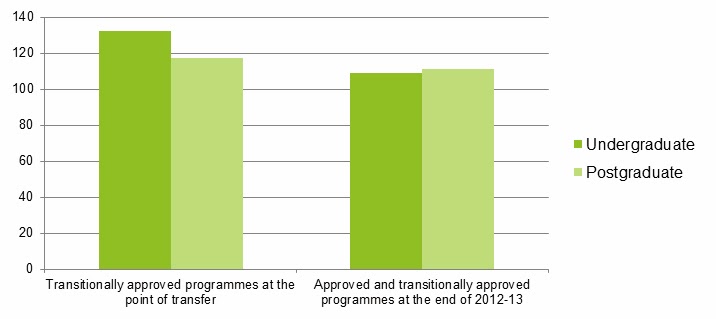
One thing we saw was a twelve per cent reduction in the number of approved and transitionally approved programmes a year after the transfer. Of the 82 education providers running transitionally approved programmes at the point of transfer, 79 continued to deliver social work programmes, with three closing their social work provision entirely. The graph below shows how these closures have affected the split between approved undergraduate and postgraduate programmes over the last year. You can read more about these changes in the full paper, which you can view on our website here.

Comparison of programme numbers at the point of transfer and at the end of the 2012–13 – by qualification level


We also noted that there were significant changes to some programmes in areas such as curriculum design and delivery, and practice placements standards as they adapted to meet our standards, but also due to the recommendations of the Social Work Task Force, including The College of Social Work’s (TCSW) Professional Capabilities Framework.

Our review shows that the approval process was implemented effectively and that we have learned from the recent onboarding of other professions, such as hearing aid dispensers and practitioner psychologists. Specifically, as part of the preparation for the onboarding of the profession, we ensured that we worked closely with TCSW, holding regular meetings and developing a suggested agenda for joint approval / endorsement events.

In the full paper, we have provided detailed analysis about which standards had a higher number of conditions set, and have discussed reasoning for why we needed to set more conditions for these standards. Education providers, in particular those who have yet to have their visit, may find the full report useful in preparing for their own visits.

In particular, we have noted that many conditions were set in several of our broad SET areas, specifically those related to curriculum and assessment (SET 4 and 6), practice placements (SET 5), and programme management (SET 3). However, it is important to note that these are not issues that are specific to social worker programmes in meeting our standards. We expect to see conditions in these areas when onboarding any new profession or visiting new programmes from existing professions.

Number of conditions for social work programmes in 2012–13 – by broad areas of the standards of education and training


Where necessary, programmes have implemented changes to ensure our regulatory requirements are met. This shows that our standards, which are designed to be broad and flexible, can be applied across different professions and education programmes.

All social work programmes that we visited in the 2012-13 academic year have now successfully completed the approval process. The programmes now have ongoing approval confirmed, subject to satisfactory monitoring. We will continue to review the outcomes from our approval visits to social work programmes on a regular basis throughout the next two academic years.

Jamie Hunt
Education Manager
HCPC


Notes:

View the full review paper at www.hcpc-uk.org/assets/documents/100042FESWapprovalreview12-13.pdf

Find out more about our education processes at www.hcpc-uk.org/education/