When the Register for social workers in England opened on 1 August 2012, we became responsible for the 249 pre-registration social work programmes that had previously been approved by the General Social Care Council (GSCC). To ensure these programmes meet our standards of education and training (SETs), we will visit each of these programmes to confirm their approval.
We held the first year of these approval visits during the 2012–13 academic year and will continue with the visits for another two years As with all professions new to the HCPC, we have completed a review of this first year of approval visits to social work programmes.
Considering the other recent, non-regulatory changes in the social work education sector, we expected there would be significant changes to education providers’ social work provision.
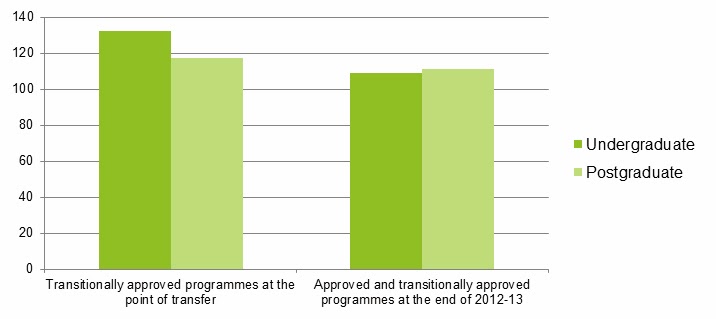
One thing we saw was a twelve per cent reduction in the number of approved and transitionally approved programmes a year after the transfer. Of the 82 education providers running transitionally approved programmes at the point of transfer, 79 continued to deliver social work programmes, with three closing their social work provision entirely. The graph below shows how these closures have affected the split between approved undergraduate and postgraduate programmes over the last year. You can read more about these changes in the full paper, which you can view on our website here.
Comparison of programme numbers at the point of transfer and at the end of the 2012–13 – by qualification level
We also noted that there were significant changes to some programmes in areas such as curriculum design and delivery, and practice placements standards as they adapted to meet our standards, but also due to the recommendations of the Social Work Task Force, including The College of Social Work’s (TCSW) Professional Capabilities Framework.
Our review shows that the approval process was implemented effectively and that we have learned from the recent onboarding of other professions, such as hearing aid dispensers and practitioner psychologists. Specifically, as part of the preparation for the onboarding of the profession, we ensured that we worked closely with TCSW, holding regular meetings and developing a suggested agenda for joint approval / endorsement events.
In the full paper, we have provided detailed analysis about which standards had a higher number of conditions set, and have discussed reasoning for why we needed to set more conditions for these standards. Education providers, in particular those who have yet to have their visit, may find the full report useful in preparing for their own visits.
In particular, we have noted that many conditions were set in several of our broad SET areas, specifically those related to curriculum and assessment (SET 4 and 6), practice placements (SET 5), and programme management (SET 3). However, it is important to note that these are not issues that are specific to social worker programmes in meeting our standards. We expect to see conditions in these areas when onboarding any new profession or visiting new programmes from existing professions.
Number of conditions for social work programmes in 2012–13 – by broad areas of the standards of education and training
Where necessary, programmes have implemented changes to ensure our regulatory requirements are met. This shows that our standards, which are designed to be broad and flexible, can be applied across different professions and education programmes.
All social work programmes that we visited in the 2012-13 academic year have now successfully completed the approval process. The programmes now have ongoing approval confirmed, subject to satisfactory monitoring. We will continue to review the outcomes from our approval visits to social work programmes on a regular basis throughout the next two academic years.
Jamie Hunt
Education Manager
HCPC
Notes:
View the full review paper at www.hcpc-uk.org/assets/documents/100042FESWapprovalreview12-13.pdf
Find out more about our education processes at www.hcpc-uk.org/education/
About the HCPC
Showing posts with label standards of eduction and training. Show all posts
18 November 2013
30 September 2013
Review of the process of HCPC approval of practitioner psychologist pre-registration education and training programmes
On 1 July 2009, the British Psychological Society (BPS) transferred its regulatory responsibilities to the HCPC and practitioner psychologists became the fourteenth profession to join the HCPC Register.
In addition to agreeing new standards for the profession, the HCPC became responsible for all the pre-registration programmes which transferred from the Society. Over the following three years, we visited each of these programmes to confirm their approval against our standards.
As with all new professions, we have undertaken a review of these visits to look at what, if any, key trends emerge.
From the review, we have identified that the approval process was implemented effectively and there were no outstanding issues specific to this profession. Importantly, this shows how our standards, which are designed to be broad and flexible, can be applied across different professions and education programmes.
The review also enabled us to identify where work was greatest over the past three years, if it was what we expected and what we can learn from the process. Specifically, we have used the findings of the review to develop the process of opening the Register to other new professions.
In particular, it has helped us to identify the most efficient way to transfer and utilise information about education and training programmes from previous regulatory or professional bodies. We have also been able to develop our communication with new professions and education professionals to make sure we effectively communicate who we are and what we do to ease the transition for those directly involved.
These developments have been put to good use as we have since welcomed hearing aid dispensers and then social workers in England onto the Register.
The findings in detail
It is clear from our review that no trends emerged that are specific to practitioner psychologist programmes when compared to programmes from the other professions we regulate. All 98 practitioner psychologist programmes we visited were granted approval or had approval reconfirmed.
Although the number of conditions set against each of the practitioner psychologist programmes varied, the overall average when compared with all other programmes visited over the same period was exactly the same. The particular standards against which conditions were set also mirrored those most commonly set on programmes from other professions.
This is a very positive outcome as the results do not suggest that a profession-specific risk profile has emerged or that there are any difficulties in meeting our regulatory standards.
We will now monitor and review how practitioner psychologist programmes interact with the established monitoring and major change processes to see if any specific trends emerge and, if so, what lessons can be learned from this.
Ben Potter
Education Manager, HCPC
Notes:
Download a copy of the full report
www.hcpc-uk.org/aboutus/committees/archive/index.asp?id=652
Detailed information on the HCPC’s approval and monitoring processes can be found here: www.hcpc-uk.org/education/processes
All HCPC- approved programmes, including practitioner psychologist programmes, appear on our register of approved programmes: www.hcpc-uk.org/education/programmes/register
In addition to agreeing new standards for the profession, the HCPC became responsible for all the pre-registration programmes which transferred from the Society. Over the following three years, we visited each of these programmes to confirm their approval against our standards.
As with all new professions, we have undertaken a review of these visits to look at what, if any, key trends emerge.
From the review, we have identified that the approval process was implemented effectively and there were no outstanding issues specific to this profession. Importantly, this shows how our standards, which are designed to be broad and flexible, can be applied across different professions and education programmes.
The review also enabled us to identify where work was greatest over the past three years, if it was what we expected and what we can learn from the process. Specifically, we have used the findings of the review to develop the process of opening the Register to other new professions.
In particular, it has helped us to identify the most efficient way to transfer and utilise information about education and training programmes from previous regulatory or professional bodies. We have also been able to develop our communication with new professions and education professionals to make sure we effectively communicate who we are and what we do to ease the transition for those directly involved.
These developments have been put to good use as we have since welcomed hearing aid dispensers and then social workers in England onto the Register.
The findings in detail
It is clear from our review that no trends emerged that are specific to practitioner psychologist programmes when compared to programmes from the other professions we regulate. All 98 practitioner psychologist programmes we visited were granted approval or had approval reconfirmed.
Although the number of conditions set against each of the practitioner psychologist programmes varied, the overall average when compared with all other programmes visited over the same period was exactly the same. The particular standards against which conditions were set also mirrored those most commonly set on programmes from other professions.
Number of conditions set on programmes between 2009 and 2012
Percentage of conditions set on programmes between 2009 and 2012
This is a very positive outcome as the results do not suggest that a profession-specific risk profile has emerged or that there are any difficulties in meeting our regulatory standards.
We will now monitor and review how practitioner psychologist programmes interact with the established monitoring and major change processes to see if any specific trends emerge and, if so, what lessons can be learned from this.
Ben Potter
Education Manager, HCPC
Notes:
Download a copy of the full report
www.hcpc-uk.org/aboutus/committees/archive/index.asp?id=652
Detailed information on the HCPC’s approval and monitoring processes can be found here: www.hcpc-uk.org/education/processes
All HCPC- approved programmes, including practitioner psychologist programmes, appear on our register of approved programmes: www.hcpc-uk.org/education/programmes/register
Subscribe to:
Posts (Atom)


