When the Register for social workers in England opened on 1 August 2012, we became responsible for the 249 pre-registration social work programmes that had previously been approved by the General Social Care Council (GSCC). To ensure these programmes meet our standards of education and training (SETs), we will visit each of these programmes to confirm their approval.
We held the first year of these approval visits during the 2012–13 academic year and will continue with the visits for another two years As with all professions new to the HCPC, we have completed a review of this first year of approval visits to social work programmes.
Considering the other recent, non-regulatory changes in the social work education sector, we expected there would be significant changes to education providers’ social work provision.
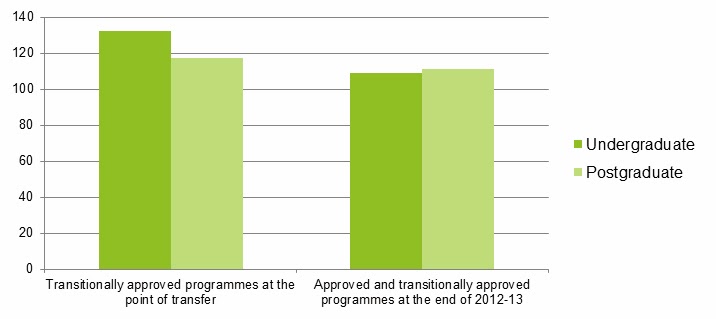
One thing we saw was a twelve per cent reduction in the number of approved and transitionally approved programmes a year after the transfer. Of the 82 education providers running transitionally approved programmes at the point of transfer, 79 continued to deliver social work programmes, with three closing their social work provision entirely. The graph below shows how these closures have affected the split between approved undergraduate and postgraduate programmes over the last year. You can read more about these changes in the full paper, which you can view on our website here.
Comparison of programme numbers at the point of transfer and at the end of the 2012–13 – by qualification level
We also noted that there were significant changes to some programmes in areas such as curriculum design and delivery, and practice placements standards as they adapted to meet our standards, but also due to the recommendations of the Social Work Task Force, including The College of Social Work’s (TCSW) Professional Capabilities Framework.
Our review shows that the approval process was implemented effectively and that we have learned from the recent onboarding of other professions, such as hearing aid dispensers and practitioner psychologists. Specifically, as part of the preparation for the onboarding of the profession, we ensured that we worked closely with TCSW, holding regular meetings and developing a suggested agenda for joint approval / endorsement events.
In the full paper, we have provided detailed analysis about which standards had a higher number of conditions set, and have discussed reasoning for why we needed to set more conditions for these standards. Education providers, in particular those who have yet to have their visit, may find the full report useful in preparing for their own visits.
In particular, we have noted that many conditions were set in several of our broad SET areas, specifically those related to curriculum and assessment (SET 4 and 6), practice placements (SET 5), and programme management (SET 3). However, it is important to note that these are not issues that are specific to social worker programmes in meeting our standards. We expect to see conditions in these areas when onboarding any new profession or visiting new programmes from existing professions.
Number of conditions for social work programmes in 2012–13 – by broad areas of the standards of education and training
Where necessary, programmes have implemented changes to ensure our regulatory requirements are met. This shows that our standards, which are designed to be broad and flexible, can be applied across different professions and education programmes.
All social work programmes that we visited in the 2012-13 academic year have now successfully completed the approval process. The programmes now have ongoing approval confirmed, subject to satisfactory monitoring. We will continue to review the outcomes from our approval visits to social work programmes on a regular basis throughout the next two academic years.
Jamie Hunt
Education Manager
HCPC
Notes:
View the full review paper at www.hcpc-uk.org/assets/documents/100042FESWapprovalreview12-13.pdf
Find out more about our education processes at www.hcpc-uk.org/education/
About the HCPC
18 November 2013
28 October 2013
Putting public protection in the spotlight
We are on the road in Gloucestershire today to officially re-launch our ‘Older, wiser …be sure’ campaign with an exclusive screening of our new film at the National Care Forum’s managers’ conference.
The ‘Be Sure’ campaign is aimed at care home managers, carers and older service users, urging them to check that their health and care professional is registered and to raise any concerns about their conduct or competence. The campaign draws on research we have done that shows most older people do not check whether the person treating them or the person they are caring for is registered.
Checking that a health and care professional is registered with us is vital because it is the only way you will know if the professional meets our national standards for training, skills and behaviour. It is also important because it offers you protection if the professional fails to meet these standards, as we can take action against registered professionals.
In order to convey this message to a wide audience in an engaging and thought-provoking way, we chose to refresh the campaign with a dramatic film that shows what can happen when things go wrong.
The film depicts three older service users, ‘Doris’, ‘Rasheed’ and ‘Rose’, who receive inadequate treatment from both registered professionals and unregistered practitioners. Meanwhile ‘David’, a stretched care home manager, learns how quick and easy it is to check the register when a professional comes to see one of his residents.
Making the film was a great learning experience for our team. We carefully researched the chosen scenarios, which are partly based on actual fitness to practise cases. To make the film as accurate and realistic as possible, we shot on location at a care home, in a hospital and at a house. We also had HCPC registrant partners involved to coach the actors on good and bad practise for their respective professions. This was a wonderful opportunity for us to interact with our partners and learn more about their roles on a day-to-day basis.
It was also a good opportunity to see professional filmmakers at work and to appreciate how much time and effort goes into getting that perfect scene. There were some great acting and make-up artist skills – keep an eye out in the film for a very realistic-looking foot sore!
I hope the work that everyone put into making the film as realistic as possible will really get people thinking about the importance of checking that their health and care professional is registered and remind them that they have recourse if things go wrong.
If you are not joining us in Gloucestershire today, you can watch the film below. We will also be showing a shorter version of the film at the Care Show in Birmingham next month, so do stop by and say hello if you will be attending.
Ebony Gayle
Media & Public Relations Manager, HCPC
Notes:
Check the register online at www.checkthregister.org
Study amongst Older People aged 70+, Ipsos MORI Research Institute for the Health Professions Council, 2008.
A short version of the film is available at: youtu.be/PO8MuHeVaYY
To find out about other regulated professions see : www.hcpc-uk.org/aboutregistration/regulators
30 September 2013
Review of the process of HCPC approval of practitioner psychologist pre-registration education and training programmes
On 1 July 2009, the British Psychological Society (BPS) transferred its regulatory responsibilities to the HCPC and practitioner psychologists became the fourteenth profession to join the HCPC Register.
In addition to agreeing new standards for the profession, the HCPC became responsible for all the pre-registration programmes which transferred from the Society. Over the following three years, we visited each of these programmes to confirm their approval against our standards.
As with all new professions, we have undertaken a review of these visits to look at what, if any, key trends emerge.
From the review, we have identified that the approval process was implemented effectively and there were no outstanding issues specific to this profession. Importantly, this shows how our standards, which are designed to be broad and flexible, can be applied across different professions and education programmes.
The review also enabled us to identify where work was greatest over the past three years, if it was what we expected and what we can learn from the process. Specifically, we have used the findings of the review to develop the process of opening the Register to other new professions.
In particular, it has helped us to identify the most efficient way to transfer and utilise information about education and training programmes from previous regulatory or professional bodies. We have also been able to develop our communication with new professions and education professionals to make sure we effectively communicate who we are and what we do to ease the transition for those directly involved.
These developments have been put to good use as we have since welcomed hearing aid dispensers and then social workers in England onto the Register.
The findings in detail
It is clear from our review that no trends emerged that are specific to practitioner psychologist programmes when compared to programmes from the other professions we regulate. All 98 practitioner psychologist programmes we visited were granted approval or had approval reconfirmed.
Although the number of conditions set against each of the practitioner psychologist programmes varied, the overall average when compared with all other programmes visited over the same period was exactly the same. The particular standards against which conditions were set also mirrored those most commonly set on programmes from other professions.
This is a very positive outcome as the results do not suggest that a profession-specific risk profile has emerged or that there are any difficulties in meeting our regulatory standards.
We will now monitor and review how practitioner psychologist programmes interact with the established monitoring and major change processes to see if any specific trends emerge and, if so, what lessons can be learned from this.
Ben Potter
Education Manager, HCPC
Notes:
Download a copy of the full report
www.hcpc-uk.org/aboutus/committees/archive/index.asp?id=652
Detailed information on the HCPC’s approval and monitoring processes can be found here: www.hcpc-uk.org/education/processes
All HCPC- approved programmes, including practitioner psychologist programmes, appear on our register of approved programmes: www.hcpc-uk.org/education/programmes/register
In addition to agreeing new standards for the profession, the HCPC became responsible for all the pre-registration programmes which transferred from the Society. Over the following three years, we visited each of these programmes to confirm their approval against our standards.
As with all new professions, we have undertaken a review of these visits to look at what, if any, key trends emerge.
From the review, we have identified that the approval process was implemented effectively and there were no outstanding issues specific to this profession. Importantly, this shows how our standards, which are designed to be broad and flexible, can be applied across different professions and education programmes.
The review also enabled us to identify where work was greatest over the past three years, if it was what we expected and what we can learn from the process. Specifically, we have used the findings of the review to develop the process of opening the Register to other new professions.
In particular, it has helped us to identify the most efficient way to transfer and utilise information about education and training programmes from previous regulatory or professional bodies. We have also been able to develop our communication with new professions and education professionals to make sure we effectively communicate who we are and what we do to ease the transition for those directly involved.
These developments have been put to good use as we have since welcomed hearing aid dispensers and then social workers in England onto the Register.
The findings in detail
It is clear from our review that no trends emerged that are specific to practitioner psychologist programmes when compared to programmes from the other professions we regulate. All 98 practitioner psychologist programmes we visited were granted approval or had approval reconfirmed.
Although the number of conditions set against each of the practitioner psychologist programmes varied, the overall average when compared with all other programmes visited over the same period was exactly the same. The particular standards against which conditions were set also mirrored those most commonly set on programmes from other professions.
Number of conditions set on programmes between 2009 and 2012
Percentage of conditions set on programmes between 2009 and 2012
This is a very positive outcome as the results do not suggest that a profession-specific risk profile has emerged or that there are any difficulties in meeting our regulatory standards.
We will now monitor and review how practitioner psychologist programmes interact with the established monitoring and major change processes to see if any specific trends emerge and, if so, what lessons can be learned from this.
Ben Potter
Education Manager, HCPC
Notes:
Download a copy of the full report
www.hcpc-uk.org/aboutus/committees/archive/index.asp?id=652
Detailed information on the HCPC’s approval and monitoring processes can be found here: www.hcpc-uk.org/education/processes
All HCPC- approved programmes, including practitioner psychologist programmes, appear on our register of approved programmes: www.hcpc-uk.org/education/programmes/register
20 August 2013
Independent prescribing for chiropodists / podiatrists and physiotherapists
Matthew Fitzpatrick, musculoskeletal specialist podiatrist
"As a podiatrist in the acute setting, I sometimes need to have the flexibility to respond to the clinical needs of patients, which was not always supported as well with previous medicines management options. Heavy reliance on medical staff, both locally and regionally, meant that there were delays in care that then affected the patient pathway.“The benefit of independent prescribing for podiatrists working as part of the overall health care team is that we can provide the right care at the right time, delivered in the right place.
"Having this option as part of the patient's pathway will mean I am able, where necessary, to positively impact the patient’s outcome as well as relieve pressure on other health care providers. Being able to implement this within the appropriate settings and with appropriate support will certainly revolutionise the way in which my colleagues and I will deliver care to our patients."
Will you be taking advantage of the opportunity to train as an independent prescriber once the programmes have been approved? How will the ability to train as an independent prescriber affect your own practice? Leave us a comment below.
If you have any questions about the new independent prescribing standards, contact us at policy@hcpc-uk.org
Charlotte Urwin
Policy Manager, HCPC
15 August 2013
Striving for good governance
HCPC has enjoyed a period of substantial growth under the direction of a strong and cohesive Council. We must maintain our UK wide focus and ensure that we recruit individuals who provide the strategic and financial oversight required. I have no doubt that we will continue to attract individuals with a wide range of skills and expertise from different arenas including service user advocacy, social care, health and psychological services, education, commerce and finance.
We also need individuals who can engage with the big, difficult issues facing public services. Recent events have revealed serious breaches of public trust and confidence in the governance of health and social care providers. Mid Staffordshire, Winterbourne, Ash Grove, Gwent, Vale of Leven and Rochdale all point towards serious failures of governance as well as failures of care. There will continue to be conversations around the HCPC table about these failures and how and why they occurred and what can be done to mitigate the risk of such failures occurring in other contexts. No-one in health and social care regulation can be complacent and HCPC has a shared responsibility with other regulators to make improvements.
The move to a smaller Council also creates the space to think about the underpinnings of good governance. We need people with a range of skills and expertise and big picture thinking, but we also need to create a governing body with shared values. One of the themes across a range of guidance documents on governance (1-4) is fidelity to values. This means not simply being able to articulate the seven principle of public life, (4) but to have an appetite to re-visit what they mean on a day to day basis, how they impact on relationships, decision making, outcomes. How they can challenge and create conflict. How they influence the culture of the organisation at every level.
It is the combination of skills, expertise and the values of public service that are critical to this new Council. We need individuals who can hold the purpose of professional regulation at the centre of corporate decision making. That purpose is to provide public protection for those who use the services of professionals on the HCPC Register. Clarity of purpose, fidelity to core values are key.
Anna van der Gaag
Chair
The HCPC
References
1. Carver, J. (2006) Boards that make a Difference. Jossey-Bass, California
2. Independent Commission on Good Governance in Public Services (2004)
http://www.jrf.org.uk/publications/good-governance-standard-public-services
3. PSA (2013) Fit and Proper? Governance in the public interest.
www.professionalstandards.org.uk
4. Committee on Standards in Public Life (2013) Standards matter: a review of best practice in promoting good behaviour in public life.
17 July 2013
What is the opposite of competence?
One of the
key responsibilities of a professional regulator is to ensure that
professionals are competent when they join the register and remain competent
throughout their working lives. HCPC sets standards of competence (called
proficiency) to do just this, and at the moment we are in a phased review of
these for 15 out of 16 of the professions we regulate. This involves extensive
review, consultation and further revisions in order to ensure that the standards
remain fit for purpose and up to date. Good regulation depends first and
foremost on having robust and credible standards which reflect professional
practice in meaningful ways.
Anna van der Gaag
ChairHCPC
NOTES
(1)
van der Gaag, A. Davies, P. (1992).The professional competence of speech
therapists: IV: Attitude and attribute base. Clinical Rehabilitation 6,4, 325-332.
Keynote,
CLEAR Congress on Professional and Occupational Regulation, Edinburgh, June
27-28, 2013 www.clearhq.org
(3)
Cavendish C. (2013) What the NHS needs is a degree of kindness.The rest can be
taught. Sunday Times, 14.7.13.
28 May 2013
Education annual report 2012
Our Education Department approves and monitors education and training programmes throughout the UK. This relates predominantly to pre-registration programmes for the 16 professions we regulate, although we do also approve a small number of programmes linked to post-registration areas of practice. Our standards of education and training (SETs) ensure that a programme that maintains its approval with us produces individuals who are fit to practice and are therefore eligible to apply to our Register. We published the Education annual report 2012 on Tuesday 7 May 2013. Here, we look at some of the key themes from our review of our approval and monitoring activities across the UK during the 2011-12 academic year.
In numbers
During this period we:
- conducted 67 approval visits assessing 110 programmes;
- reviewed 256 annual monitoring declarations and 221 annual monitoring audit submissions;
- considered 316 major change notifications;
- investigated four concerns raised about approved programmes that were within our remit; and
- transferred 269 social work pre-registration programmes and 27 approved mental health professional (AMHP) programmes to our register of approved education and training programmes following the transfer of social workers in England from the General Social Care Council on 1 August 2012.
Conditions for new programmes
A key area of growth over the last three years related to new programmes for practitioner psychologists and hearing aid dispensers following the opening of these Registers in July 2009 and April 2010 respectively. We concluded the schedule of approval visits to these programmes in summer 2012.
A common theme across these programmes was the number of conditions we applied on approval that related to practice placements. Our SETs require an education provider to hold overall responsibility for placement provision. Conditions in this area are therefore often focused on the quality assurance arrangements the education provider has in place to manage these important areas of teaching and learning.
This is a trend we often see with new profession programmes that transfer over to us and with new programmes from our existing professions. Our Visitors normally ask for further evidence that education providers are well placed to manage practice placements and that placement educators are equipped to provide appropriate learning experiences. This often means education providers must demonstrate that there are formal, documented arrangements underpinning the relationships they have with their placement providers. When considered in this context, these results do not suggest any profession-specific risk profile for either new profession.
To help address this across all professions, we have been delivering seminars for the past two academic years that are focused on supporting education providers in their management of placements. For these seminars, we invited both education providers and placement educators to attend as we recognise the important role they each play in ensuring the education experience meets our standards. These seminars were well attended by representatives from the majority of our professions and facilitated useful discussions about different approaches to the management of placement provision.
The MSC initiative
The Modernising Scientific Careers (MSC) initiative – a workforce strategy from the Department of Health – has also had an impact on education programme numbers, with the creation of 16 new biomedical scientist programmes in 2011-12, which we approved. We also approved a new route to registration for clinical scientists modeled against the new MSC scientific training pathway. It is possible that we may see the creation of more new biomedical scientist and clinical scientist programmes in future years as a result of the MSC initiative.
These developments suggest that our standards remain fit for purpose and can be appropriately applied to a range of professions and models of education and training for the professions we regulate.
Monitoring
When compared over the last five years, it is clear that our monitoring workload is growing. For annual monitoring, we have seen an increase of 85 per cent between 2007-08 and 2011-12. Major change notifications also increased by 32 per cent in the 2010-11 academic year. These increases are expected each year, because as we approve more programmes, more programmes are subject to meeting our monitoring processes. We anticipate further growth as practitioner psychologist and hearing aid dispenser programmes move into our monitoring cycle.
We required additional documentation for 41 per cent of annual monitoring audit submissions. This is comparable with the results from last year, which reflects the requirement for education providers to show how they meet the revised SETs implemented in September 2009. All programmes in the annual monitoring cycle have now provided this evidence and we expect the number of requests for additional documentation to fall again next year accordingly.
No programmes required a further approval visit as a result of an audit submission and only 2 programmes required a further approval visit as a result of a major change submission. We only decide to conduct an onsite approval visit when the changes submitted by an education provider have significantly changed the way their programme meets our standards. Pleasingly, these results mean our model of open-ended approval is achieving the task it was set out to do: preventing the need for cyclical re-approval visits where possible.
Looking ahead
We anticipate the majority of our approval and monitoring work over the next three academic years to be focused on the schedule of visits to social work and approved mental health professional (AMHPs) programmes in England.
As with all new professions, we will undertake a review of these visits each year to inform our own approval and monitoring approach for these professions and the application of our standards. This review will also feed into future seminar topics and stakeholder liaison that we conduct with the social work profession.
Brendon Edmonds
Acting Director of Education, HCPC
Notes:
You can download a copy of the full Education annual report 2012 here: www.hcpc-uk.org/publications/reports
Further information on the HCPC’s approval and monitoring activities can be found here: www.hpc-uk.org/education
All programmes approved by the Education and Training Committee for meeting our SETs appear on our register of approved programmes: www.hcpc-uk.org/education/programmes/register
Subscribe to:
Posts (Atom)